
LOS in Insurance: What Banks and NBFCs Need to Know
Written by
Shalini
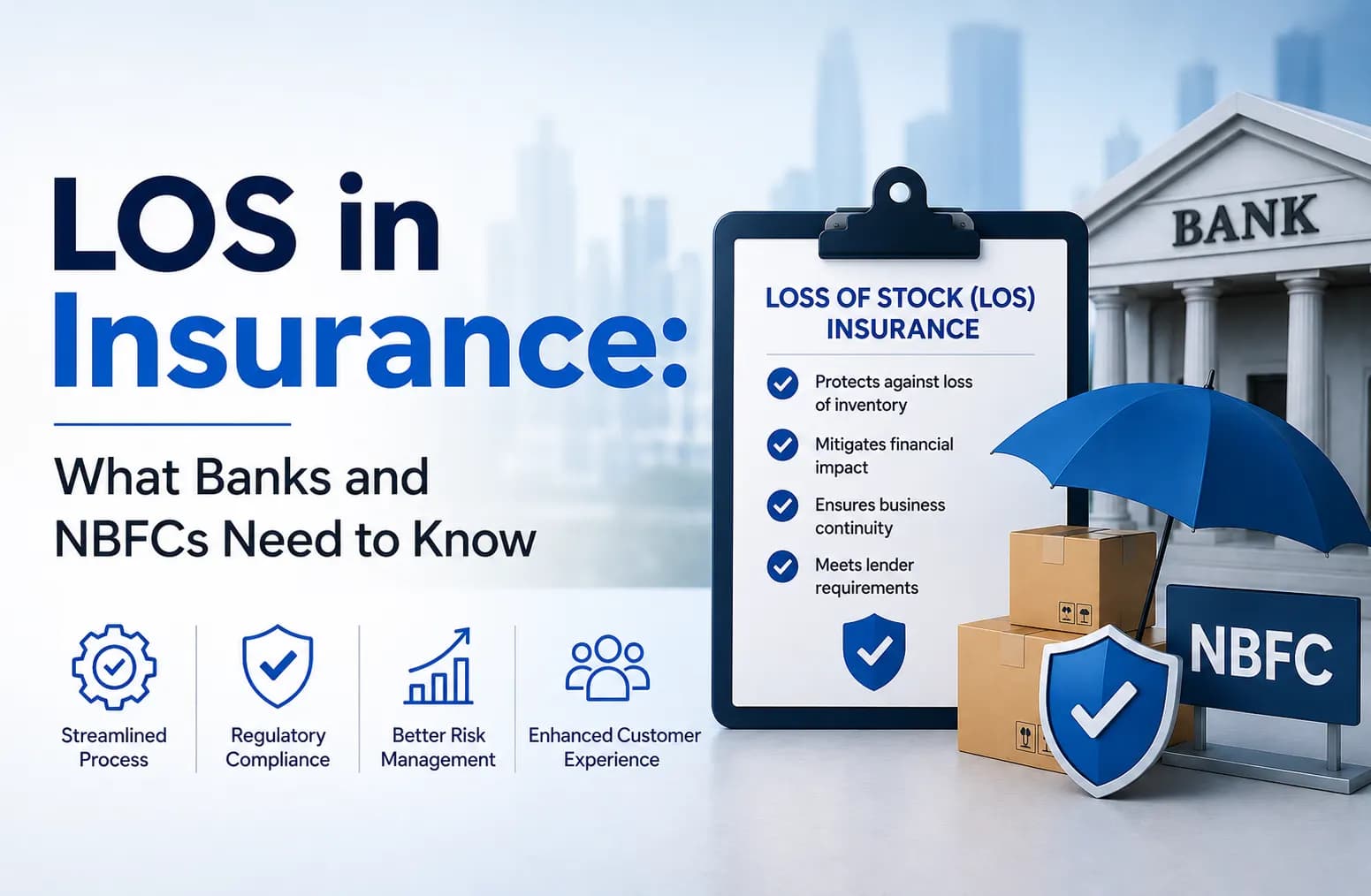
A Loan Origination System (LOS) in insurance refers to the integration of insurance product workflows, including credit life, property, and credit shield cover, directly into a bank or NBFC's loan processing pipeline. This allows lenders to present, obtain consent for, calculate premiums on, and issue insurance policies at the point of loan origination, without separate systems or manual handoffs. Key benefits include higher insurance penetration, regulatory compliance with IRDAI and RBI guidelines, cleaner audit trails, and additional commission revenue for institutions acting as corporate agents.
The financial services landscape has changed dramatically over the last decade. Banks and Non-Banking Financial Companies (NBFCs) are no longer just lenders. They are full-service financial institutions that bundle insurance products alongside loans, offer credit-linked coverage, and act as corporate agents for insurers. At the heart of this transformation is one critical piece of technology: the Loan Origination System (LOS).
If you are running lending operations at a bank or NBFC, your LOS is not just a loan processing tool anymore. It is the nerve center of your insurance distribution pipeline. And yet, many institutions still treat LOS and insurance as separate systems. That disconnect costs time, money, and customer trust.
This blog breaks down what LOS means in the context of insurance, why it matters, and what banks and NBFCs need to get right.
What Is a Loan Origination System (LOS)?
A Loan Origination System is software that automates and manages the end-to-end process of loan creation, from application intake to underwriting, approval, documentation, and disbursal.
A modern LOS handles:
Borrower onboarding and KYC verification
Credit bureau pulls and risk scoring
Document collection and verification
Underwriting rules and credit decisioning
Regulatory compliance checks
Loan agreement generation and e-signing
Disbursal triggers and post-disbursement tracking
For banks and NBFCs that offer insurance as part of the lending journey, the LOS becomes the primary touchpoint for insurance integration.
The Insurance Dimension: Why It Belongs Inside the LOS
When a bank disburses a home loan, a personal loan, or a business loan, insurance often comes with it. Credit life insurance protects the lender if the borrower dies. Property insurance protects collateral. Credit shield products protect against job loss or disability.
In most institutions today, this insurance journey still runs in parallel to the loan journey. The loan team processes the application in the LOS, and the insurance is handled separately through a different system, a call center, or even a manual form. This creates:
Duplicate data entry -- borrower details are captured twice, in different systems, with different formats.
Compliance gaps -- IRDAI mandates specific disclosures, consent capture, and policy documentation. If insurance is handled outside the LOS, these steps are easy to miss.
Poor customer experience -- borrowers have to engage with multiple touchpoints for what they perceive as a single product.
Revenue leakage -- without LOS-embedded triggers, insurance cross-sell opportunities fall through the cracks at the moment of highest intent.
The solution is integrating insurance workflows directly into the LOS so that the lending and insurance journeys run as one.
How LOS Integration Works in Insurance
A well-integrated LOS handles insurance in three layers.
1. Product Mapping and Eligibility
At the application stage, the LOS uses loan parameters -- amount, tenure, borrower age, collateral type -- to map eligible insurance products. A housing loan above a certain ticket size might trigger a mandatory property insurance requirement. A personal loan might surface optional credit life cover. The LOS does this automatically, without the loan officer needing to remember product rules.
2. Consent and Disclosure Management
IRDAI regulations require explicit, informed consent before any insurance product is sold. The LOS must capture this consent digitally, log it with a timestamp, and store it as part of the loan file. It must also display standardized disclosures around premium amounts, coverage terms, exclusions, and the voluntary nature of optional products. Embedding this inside the LOS ensures it cannot be skipped.
3. Premium Calculation and Policy Issuance
Once the borrower opts in, the LOS connects to the insurer's API in real time to calculate the premium based on the borrower's profile, loan amount, and tenure. The premium is either added to the loan (single-premium model) or set up as a recurring deduction. After acceptance, the insurer issues the policy number, and the LOS stores it against the loan record. No separate system. No manual handoff.
Regulatory Context: What IRDAI and RBI Expect
Banks and NBFCs operating as corporate agents or insurance distribution partners must comply with both RBI and IRDAI guidelines. Non-compliance is not a minor inconvenience. It can result in penalties, license suspension, and reputational damage.
Key regulatory requirements relevant to LOS-integrated insurance include:
IRDAI Corporate Agent Regulations, 2015 (amended): Corporate agents cannot force insurance on borrowers. The LOS must distinguish between mandatory insurance (where the lender has a valid insurable interest, such as property insurance for a mortgage) and optional insurance (credit life, credit shield). Optional products must be presented as such, with clear opt-in mechanisms.
RBI Master Directions on Loans: RBI prohibits lenders from making optional insurance a condition for loan approval. The LOS must be configured to allow loan processing to proceed even when a borrower declines optional insurance, and the system audit trail must reflect this.
IRDAI Point of Sale (POS) Guidelines: Many lenders distribute simplified insurance products through POS channels. The LOS must support the eligibility filters that restrict POS products to compliant use cases -- for example, age limits, sum assured caps, and product types.
Data Protection and Privacy: Borrower data shared with insurers must be governed by a data-sharing agreement. The LOS must log every data transfer to an insurance partner, specifying what data was shared, when, and for what purpose.
Institutions that have not audited their LOS for these requirements are exposed. A compliance-first LOS configuration is not optional -- it is table stakes.
Benefits for Banks and NBFCs
Getting this integration right delivers measurable value across the business.
Increased Insurance Penetration
When insurance is presented at the right moment in the lending journey, conversion rates are significantly higher than outbound or post-disbursal selling. The LOS creates a captive, high-intent moment. Banks and NBFCs that have embedded insurance into the LOS consistently report penetration rates 2x to 3x higher than those using separate sales processes.
Lower Operational Cost
Eliminating duplicate data entry and manual handoffs reduces processing time per loan. It also reduces errors that lead to policy rejections, claims disputes, and customer escalations. Fewer touchpoints mean fewer failure points.
Better Credit Risk Management
Mandatory insurance on secured loans directly reduces the lender's credit risk. A borrower with credit life cover is a lower-risk borrower from a portfolio perspective. LOS integration ensures insurance is consistently attached where it reduces risk, not just where a sales agent remembers to offer it.
Cleaner Audit Trails
Regulators want to see that insurance was offered fairly, disclosures were made, and consent was captured. An integrated LOS produces a single, auditable record for every loan that includes all insurance-related steps. This is far more defensible than trying to reconstruct a paper trail across multiple systems.
Revenue from Distribution Commissions
Banks and NBFCs acting as corporate agents earn commissions on every policy sold. With LOS integration, the distribution engine runs at scale. More loans processed automatically means more policies issued and more commission income, without proportional increases in headcount.
Common Integration Challenges
Despite the clear benefits, many institutions run into the same obstacles when trying to integrate insurance into their LOS.
Legacy LOS architecture: Older systems were not built with API connectivity in mind. Adding insurance integrations often requires middleware layers or custom development that increases maintenance burden.
Multiple insurer partnerships: A lender may work with three or four insurance partners across different product lines. Each insurer has its own API, data schema, and documentation standards. The LOS must handle all of them, ideally through a normalized integration layer.
Change management: Loan officers are incentivized on loan disbursals, not insurance penetration. Without deliberate training and incentive realignment, they will route around the new process.
Product configuration flexibility: Insurance products change. Insurers update premiums, revise coverage terms, or introduce new products. The LOS must allow insurance product configuration to be updated without code changes or IT involvement.
Testing and UAT: Insurance integrations involve external APIs, real-time premium calculations, and downstream policy issuance. Thorough testing in a sandboxed environment is essential before go-live. Many institutions underestimate the time this takes.
What a Modern LOS Should Offer
If you are evaluating or upgrading your LOS with insurance integration in mind, here is what the system should deliver.
A modern LOS should have native or configurable API connectors to insurance partners, eliminating the need for custom middleware in most cases. It should support both mandatory and optional insurance workflows, with configurable rules for when each applies. Consent capture should be embedded in the borrower-facing journey, not handled as a post-process. The system should generate compliant disclosures automatically based on the product and jurisdiction. Premium calculations should happen in real time, not as batch processes. Policy numbers and documents should be stored against the loan record from day one.
For NBFCs that operate across multiple geographies or product lines, the LOS should support multi-product and multi-insurer configurations from a single platform. This reduces complexity, reduces cost, and makes regulatory reporting manageable.
The Bancassurance Opportunity
For banks specifically, LOS-integrated insurance is part of a larger bancassurance strategy. Bancassurance accounts for a significant and growing share of insurance premium in India, and IRDAI has been progressively opening up the framework to allow banks to work with more than one insurance partner in each category.
The opportunity is real, but capturing it requires infrastructure. A bank that processes 10,000 loans a month with a manual insurance attach process is leaving significant premium volume on the table. The same bank with a well-configured LOS can turn every loan origination into an insurance distribution event, at zero marginal cost per transaction.
NBFCs have a similar opportunity, particularly in segments like gold loans, microfinance, and vehicle loans where insurance is directly relevant to the collateral or borrower profile. Microfinance NBFCs, in particular, have found that embedding life and health insurance into the loan origination journey significantly improves borrower retention and reduces default-related losses.
Steps to Get Started
For banks and NBFCs that are not yet running insurance through their LOS, the path forward involves a few clear steps.
Start with a compliance audit. Understand what your current state is -- what insurance you are selling, through what process, with what consent and disclosure mechanisms, and how it is documented.
Map your product portfolio. Identify which insurance products map to which loan types and what the eligibility logic should be. Mandatory versus optional, sum assured rules, age limits, and tenure matching should all be documented before configuration begins.
Evaluate your LOS's integration capability. Determine whether your current system can support insurance API integrations, or whether you need a new system or a middleware layer. Get a clear picture of the development and maintenance cost.
Engage your insurance partners early. Policy issuance APIs vary significantly in quality and documentation. Starting integration conversations with your insurers early will surface technical constraints before they become project blockers.
Train your teams. Operations, credit, and customer-facing teams all need to understand the new workflow. Loan officers need to know how to handle borrower questions about insurance, how to record declinations, and what they can and cannot say under IRDAI regulations.
Conclusion
LOS-integrated insurance is no longer a nice-to-have for banks and NBFCs. It is the baseline for efficient, compliant, and profitable insurance distribution through lending channels.
The institutions that get this right will earn more commission income, carry less credit risk, produce cleaner compliance records, and deliver a better borrower experience. Those that continue to run insurance as a parallel, manual process will face mounting regulatory pressure and competitive disadvantage as the market matures.
If you are building or upgrading your LOS, insurance integration belongs on the requirements list from day one, not as an afterthought.
- A Loan Origination System (LOS) is the ideal place to embed insurance distribution, as it captures borrowers at the moment of highest intent.
- Running insurance as a separate, parallel process creates compliance gaps, duplicate data entry, and revenue leakage.
- LOS-integrated insurance works across three layers: product mapping and eligibility, consent and disclosure management, and real-time premium calculation with policy issuance.
- IRDAI and RBI regulations require mandatory versus optional insurance to be clearly separated, with digital consent, standardized disclosures, and a full audit trail.
- Banks and NBFCs with LOS-embedded insurance consistently see 2x to 3x higher penetration rates compared to manual or outbound insurance sales.
- Common challenges include legacy LOS architecture, managing multiple insurer APIs, and change management with loan officer teams.
- A modern LOS should support configurable insurance product rules, real-time insurer API connectivity, and compliant consent capture out of the box.
- Bancassurance and NBFC-linked insurance distribution are significant and growing revenue opportunities that require scalable LOS infrastructure to capture.
Have any questions?
What does LOS mean in the context of insurance for banks and NBFCs?
LOS stands for Loan Origination System. In the insurance context, it refers to the integration of insurance product workflows directly into the loan processing pipeline. Instead of handling insurance separately, banks and NBFCs use the LOS to present insurance options, capture borrower consent, calculate premiums, and trigger policy issuance as part of the same journey in which the loan is originated.
Is it mandatory for banks and NBFCs to offer insurance during loan origination?
It depends on the product type. Property insurance on a secured loan (like a home loan) can be mandatory because the lender has a direct insurable interest in the collateral. However, credit life, credit shield, and other personal insurance products are optional and must be presented as such. RBI regulations explicitly prohibit lenders from making optional insurance a condition for loan approval. The LOS must be configured to enforce this distinction.
How does LOS integration help with IRDAI compliance?
An integrated LOS automates the compliance steps that are easiest to miss in a manual process. It generates standardized product disclosures, captures and timestamps borrower consent digitally, logs all data shared with the insurer, and stores policy documents against the loan record. This creates a complete, auditable trail for every insurance transaction, which is exactly what IRDAI and RBI expect during inspections or audits.
Can a bank or NBFC connect multiple insurance partners through a single LOS?
Yes, and for most institutions this is the right approach. A lender may work with one partner for credit life, another for property insurance, and a third for health or credit shield products. A modern LOS supports multiple insurer API connections through a normalized integration layer, so loan officers and borrowers interact with one consistent workflow regardless of which insurer sits behind a particular product.
What is the difference between mandatory and optional insurance in a LOS workflow?
Mandatory insurance is automatically attached to eligible loans based on configured rules, for example, property insurance on every home loan above a certain loan-to-value ratio. The borrower is informed but cannot opt out. Optional insurance is surfaced as an offer during the origination journey. The borrower must actively opt in, consent must be captured, and the loan must be able to proceed if they decline. The LOS handles both flows but must keep them distinct for regulatory and audit purposes.
How long does it take to integrate insurance into an existing LOS?
The timeline varies significantly depending on the architecture of the existing LOS, the number of insurance partners being integrated, and the complexity of the product configuration. A greenfield integration with a modern, API-ready LOS and a single insurer partner can go live in 8 to 12 weeks. Integrations involving legacy systems, multiple insurers, or complex product rules typically take 4 to 6 months including testing and UAT. Starting insurer API conversations early is the single biggest factor in keeping timelines on track.

Ready to distribute health insurance at scale?
Talk to the Deployit team for a 30-minute walkthrough.