
Policy Renewal Automation: How to Stop Losing Customers at Expiry
Written by
Deployit
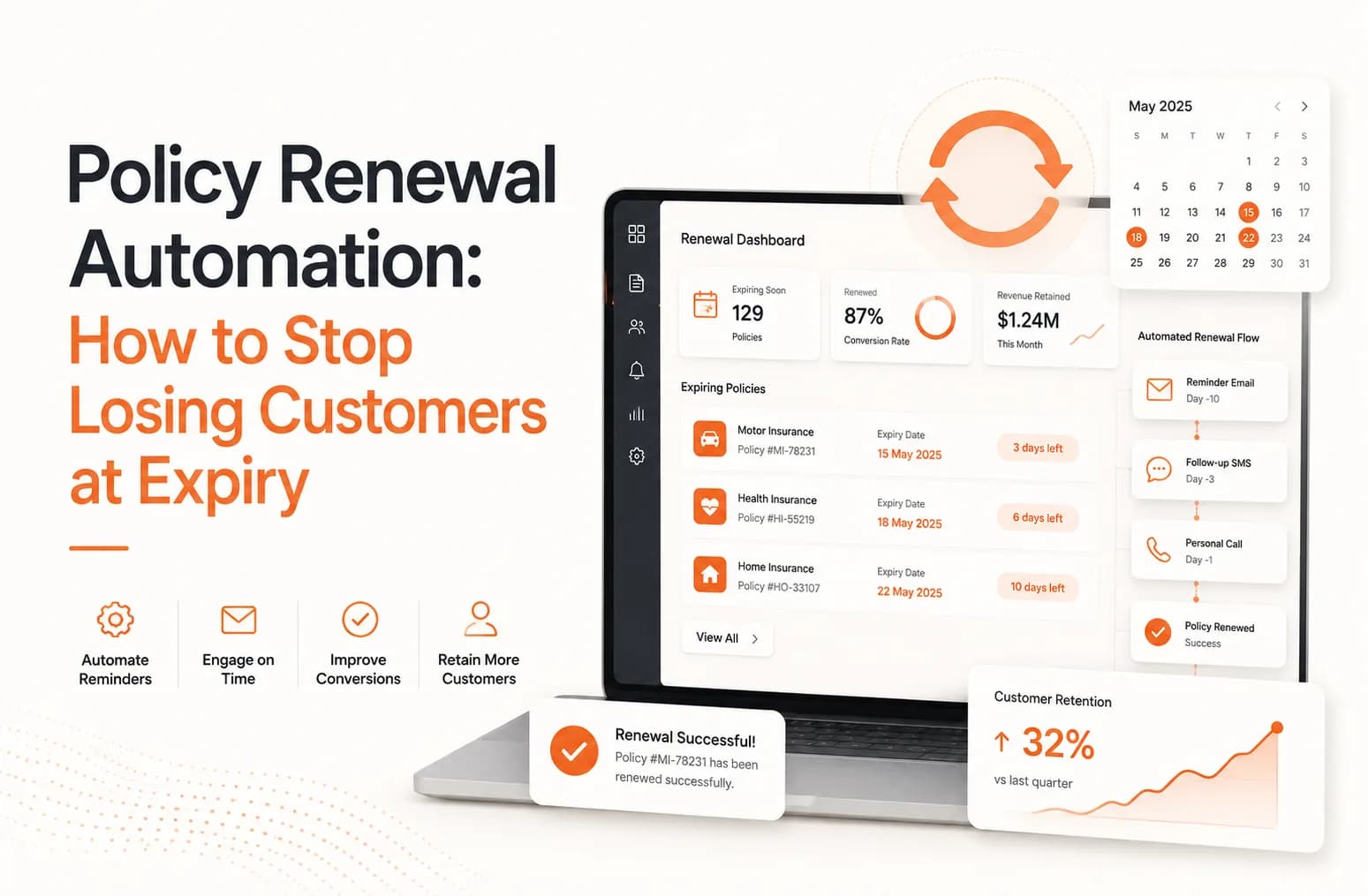
Policy renewal automation uses software to trigger timely reminders, personalized outreach, and one-click renewal flows before a policy expires, so customers renew without friction and agents spend less time chasing. When implemented well, it eliminates the single biggest cause of preventable churn in insurance: customers who intended to renew but simply forgot or never heard from you in time.
What Is Policy Renewal Automation?
Policy renewal automation is the practice of using software to manage the entire renewal lifecycle without requiring manual intervention at every step. Instead of relying on agents to remember which policies expire when, a renewal automation system monitors expiry dates across your entire book of business and triggers a sequence of actions, such as reminder emails, SMS nudges, and agent alerts, based on rules you define.
At its core, the system connects your policy management data to your communication tools and customer portal. When a policy crosses a configurable threshold, say 90, 60, or 30 days from expiry, the platform begins a structured outreach sequence. Each touchpoint is logged, and responses (opens, clicks, renewals, declines) feed back into the system, so your team always knows where each customer stands.
This is different from simply scheduling a few reminder emails. True renewal automation includes dynamic pricing updates, pre-filled renewal documents, digital signature collection, and payment processing, all within a single flow that the customer can complete in minutes.
Why Do Customers Lapse at Renewal?
Understanding why customers lapse is the first step to stopping it. The most common reasons are not price disagreements or deliberate cancellations. They are operational failures: the customer never received a reminder, the renewal process felt too complicated, or the agent followed up too late to recover the relationship.
Research across insurance verticals consistently shows that a large portion of lapsed policies is due to policyholders who had no active intent to cancel. They simply did not act in time, and no one made it easy or urgent enough for them to do so.
There are a few structural reasons this happens at scale:
Fragmented data. When policy records live in one system and communication tools live in another, renewal dates slip through the cracks. Agents work from spreadsheets or memory rather than reliable automated alerts.
Generic outreach. A single reminder email sent 30 days before expiry, addressed to "Dear Customer," does not drive action. Customers tune it out alongside every other generic marketing email they receive.
Friction-heavy renewal flows. If renewing requires a customer to call an agent, fill out a paper form, or navigate a confusing portal, many will delay until it is too late. Friction kills intent.
Reactive agent workflows. Without automation, agents respond to lapsed policies after the fact rather than preventing them. Re-acquiring a lapsed customer costs significantly more than retaining one.
How Does Renewal Automation Actually Work?
A modern renewal automation platform works in a continuous loop across four stages.
Stage 1: Monitoring. The system scans your policy data in real time and flags policies approaching expiry. You set the rules: which lines of business, which renewal windows, which customer segments.
Stage 2: Outreach. Automated sequences begin at the right time for each customer. A commercial lines client might receive an outreach sequence starting 90 days out. A personal auto customer might start receiving reminders 45 days before expiry. Each message is personalized with the customer's name, policy details, and a direct renewal link.
Stage 3: Action. The customer clicks a link, reviews their coverage, confirms or adjusts it, signs digitally, and pays, all in one session. The system handles the confirmation and updates the policy record automatically.
Stage 4: Recovery. For customers who do not engage, the system escalates. It routes those accounts to agents with a prioritized task, relevant context (how many times the customer was contacted, what they clicked), and a suggested script. This turns agent time toward the accounts that need a human touch rather than drowning them in low-risk renewal admin.
To see how this works in practice, explore Deployit's automated workflow engine and policy lifecycle management features.
What Are the Business Results of Automating Renewals?
The impact of renewal automation shows up in three places: retention rates, agent productivity, and revenue predictability.
Retention rates improve because customers receive timely, relevant outreach that makes renewing easy. When the path of least resistance is to click a link and be done in two minutes, most customers take it. Teams using dedicated renewal automation consistently report meaningful reductions in lapse rates within the first policy cycle after implementation.
Agent productivity increases because agents stop doing work that software can do. Instead of manually calling every policyholder 30 days before expiry, agents receive a targeted list of accounts that need a conversation: high-value customers, those showing hesitation signals, or complex commercial accounts where automated outreach is not enough on its own.
Revenue becomes more predictable because renewal rates stabilize. Your book of business compounds rather than erodes. Accurate renewal forecasting also improves because the system gives you visibility into which policies are on track and which are at risk, weeks before expiry rather than days after.
For a deeper look at how renewal automation connects to your broader revenue strategy, read our post on reducing customer churn in insurance and building a data-driven retention strategy.
What Should You Look for in a Renewal Automation Platform?
Not all renewal automation tools are built for insurance. Here is what to prioritize when evaluating options.
Native policy data integration. The platform should connect directly to your policy management system so renewal dates, coverage details, and customer records are always current. Manual data imports create lag and errors.
Multi-channel outreach. Email alone is not enough. The best platforms combine email, SMS, and in-app notifications, with channel selection driven by customer communication preferences, not one-size-fits-all defaults.
Configurable renewal rules. Different lines of business have different renewal dynamics. A platform that lets you define separate sequences for personal lines, commercial lines, and specialty products is far more effective than one with a single global workflow.
Digital renewal experience. The renewal journey itself matters. Customers need to be able to review their policy, make changes, sign, and pay without picking up a phone. Look for platforms with embedded e-signature and payment processing, not bolt-on third-party tools that break the experience.
Agent escalation workflows. Automation should handle volume; agents should handle relationships. A good platform routes the right accounts to agents with full context, so no high-value customer slips through because the system assumed they were fine.
Reporting and audit trails. You need to know what was sent, when, and what happened next. Solid reporting also helps you optimize your sequences over time based on what actually drives renewals.
Deployit's renewal automation feature is built specifically for insurance carriers and MGAs, with all of the above built in rather than bolted on.
How Early Should You Start the Renewal Process?
The answer depends on the line of business, but starting earlier than you think necessary is almost always the right call.
For personal lines (auto, home, renters), 45 to 60 days before expiry is a reasonable starting point for the first outreach. This gives customers time to review their coverage, shop if they want to, and still return to renew. Starting too late means you are competing with quotes they have already collected from competitors.
For commercial lines and specialty products, 90 to 120 days is more appropriate. These customers often need time to review coverage limits, consult with advisors, or obtain updated valuations. An early start also gives your underwriting team time to prepare renewal terms without a last-minute scramble.
The key principle: the renewal process should feel collaborative and proactive, not panicked and reactive. Customers who feel like their insurer is on top of their account are far more likely to stay.
Ready to Stop Losing Customers at Renewal?
Every lapsed policy is revenue that was left because the process failed, not because the customer decided to leave. Renewal automation fixes the process, so your team is never caught chasing an expiry that should have been handled weeks earlier.
Book a free Deployit demo to see how our renewal automation platform helps insurance teams retain more customers with less manual effort.
- Policy renewal automation triggers personalized reminders and one-click renewal flows automatically, reducing lapse rates without adding agent workload.
- Most customers who lapse at renewal did not intend to cancel. They were let down by late, generic, or friction-heavy outreach.
- Effective automation covers the full cycle: monitoring expiry dates, multi-channel outreach, digital renewal completion, and agent escalation for high-risk accounts.
- Starting the renewal sequence 45 to 90 days before expiry (depending on line of business) gives customers enough time to act and agents enough time to recover hesitant accounts.
- The right platform integrates natively with your policy management system and handles e-signature and payment in a single customer session.
Have any questions?
What is policy renewal automation
Policy renewal automation uses software to monitor policy expiry dates and trigger a structured sequence of reminders, digital renewal flows, and agent escalations so customers renew without manual follow-up from your team.
Why do customers lapse at renewal?
Most lapses are caused by operational failures, not deliberate cancellations. Customers forget to renew, receive reminders too late, or find the renewal process too complicated to complete in time.
How does renewal automation work?
Renewal automation works in four stages: monitoring expiry dates, sending personalized multi-channel outreach, enabling digital self-service renewal (review, sign, pay), and routing unresponsive accounts to agents with full context.
How early should you start the renewal process?
For personal lines, begin outreach 45 to 60 days before expiry. For commercial lines and specialty products, start 90 to 120 days out to give customers and underwriters enough time to prepare.
What should you look for in a renewal automation platform?
Look for native policy data integration, multi-channel outreach (email, SMS, in-app), configurable rules per line of business, a built-in digital renewal experience with e-signature and payment, agent escalation workflows, and robust reporting.

Ready to distribute health insurance at scale?
Talk to the Deployit team for a 30-minute walkthrough.