
What is Embedded Insurance? A Guide for Indian Banks and NBFCs
Written by
Yash
Dev
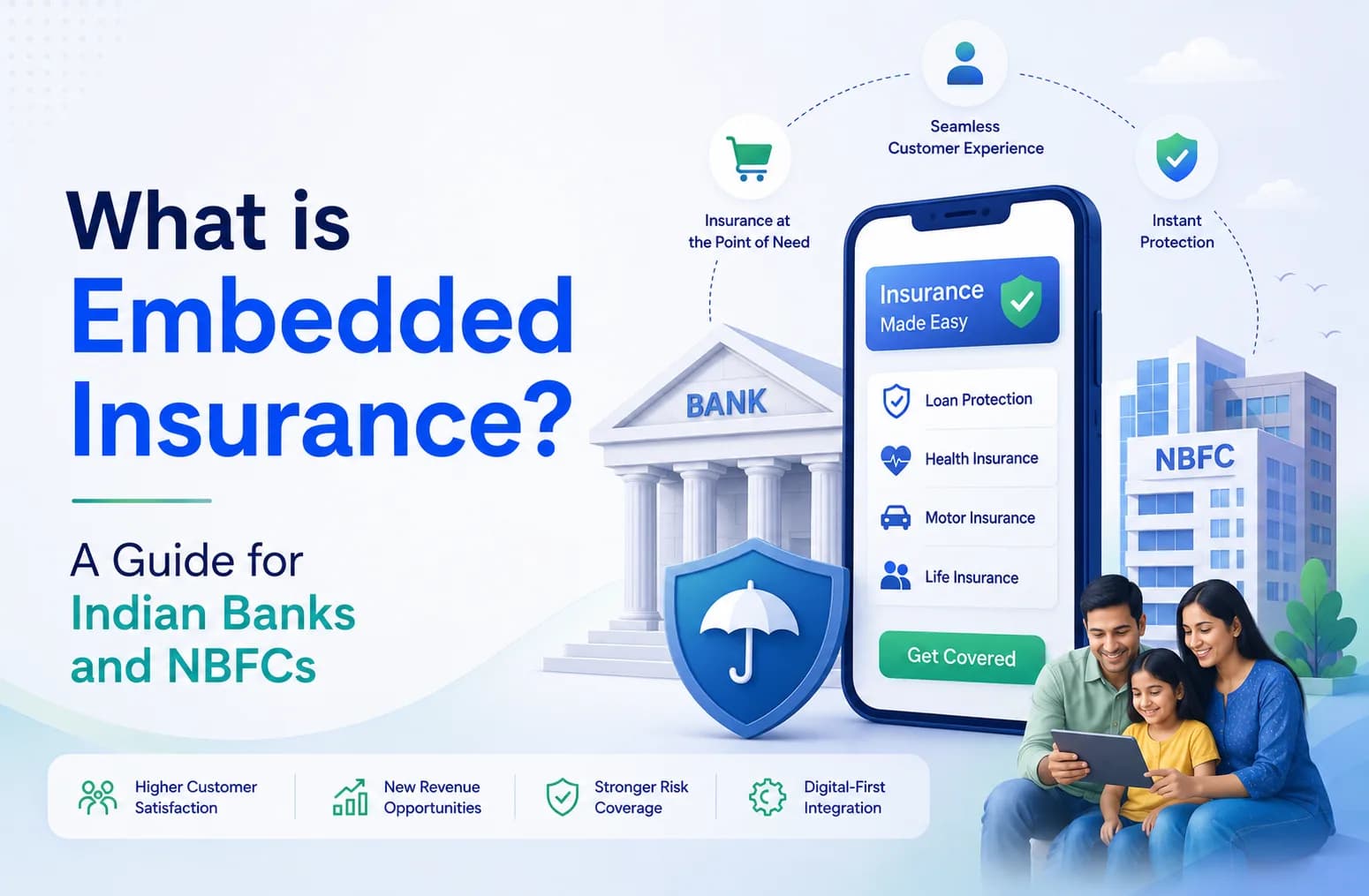
Embedded insurance is the integration of insurance products directly into a non-insurance platform at the moment a customer needs them most. Instead of asking customers to visit a separate insurer, banks and NBFCs bundle coverage into their existing loan disbursals, account openings, or payment flows. For Indian financial institutions sitting on millions of underserved customers, this model turns every transaction into a distribution opportunity.
How Does Embedded Insurance Actually Work?
Embedded insurance operates through three layers working together: a financial institution's customer-facing product, an API middleware layer, and an insurer's policy engine.
When a customer takes a personal loan, the platform detects the event in real time. The API queries the insurer, generates a relevant offer (say, a credit life cover or a job loss cover), and presents it inside the same screen where the customer is already making a decision. The customer accepts with a single tap. The policy is issued, the premium is collected, and the insurer is notified, all within the same transaction session.
For banks and NBFCs, the practical steps look like this:
Choose an embedded insurance platform with pre-integrated insurer partnerships (such as Deplyit's insurance integration suite).
Connect via REST API to your existing loan management system or mobile banking app.
Configure which insurance product maps to which customer event (home loan disbursed, credit card activated, two-wheeler loan sanctioned).
Set premium collection rules and commission reconciliation parameters.
Go live and monitor policy issuance through a unified dashboard.
No separate insurance license is required. Your institution acts as a corporate agent or through an insurance marketing firm arrangement, which IRDAI already permits for banks and NBFCs.
Why Does India Need Embedded Insurance Now?
India's insurance gap is one of the largest in the world. Insurance penetration stood at just 3.7% of GDP in FY 2025, with life insurance at 2.7%. Less than 10% of the population holds any insurance coverage whatsoever. Meanwhile, banks and NBFCs collectively touch hundreds of millions of customers through Jan Dhan accounts, MSME loans, vehicle finance, and personal credit.
Three structural shifts are converging to make this the right moment:
The regulatory green light is on. IRDAI's Bima Trinity framework, rolled out between 2024 and 2026, is designed to push insurance distribution through every available financial channel, including banks and NBFCs. The regulatory sandbox has also been expanded to allow embedded insurance innovation across the value chain.
Customers are ready. A 2025 survey found that 91% of digital banking customers in India said they would accept an embedded insurance offer if it were presented conveniently, and 63% cited convenience as their primary motivator.
The revenue case is clear. India's embedded finance market is growing at 46% annually and is projected to hit USD 24.03 billion in 2025 alone. Embedded insurance within this ecosystem is expected to exceed USD 2 billion by 2026.
What Types of Insurance Can Banks and NBFCs Embed?
The product range is broader than most institutions realise. Common use cases for Indian financial institutions include:
Credit life insurance attached to personal loans, home loans, and MSME credit. This is the most common starting point and has near-automatic uptake since it directly protects the loan repayment.
Vehicle insurance bundled with two-wheeler and four-wheeler loans at the point of disbursement. Regulatory compliance requirements for motor insurance make this a natural fit.
Health and hospital cash cover offered alongside salary accounts, credit cards, or consumer durable loans.
Crop and parametric insurance distributed through rural NBFCs and microfinance institutions, triggered by weather data or satellite-indexed events.
Home insurance linked to mortgage disbursals, covering structure and contents from day one.
Each of these maps to a moment your institution already owns. The customer is already in your app, already trusting your brand, already completing a financial action. Embedding insurance into that moment requires no additional acquisition cost.
How Does Embedded Insurance Benefit Banks and NBFCs Specifically?
Beyond the headline revenue line, embedded insurance delivers four concrete advantages for regulated financial institutions in India.
Fee income diversification. Commission income from insurance does not attract credit risk or provisioning requirements. For NBFCs navigating tighter capital norms, this is a particularly attractive income stream.
Loan book protection. Credit life and job loss covers reduce the probability of default when a borrower faces an adverse life event. Banks embedding these products are, in effect, hedging their own portfolios.
Customer lifetime value. Research consistently shows that customers holding more than one product with a financial institution have significantly higher retention rates. An insurance policy sold at loan disbursement is a second touchpoint that extends the relationship.
Regulatory goodwill. IRDAI and RBI have both signalled that deepening insurance penetration is a national priority. Institutions actively contributing to this goal tend to receive more constructive engagement during supervisory reviews.
You can see how these advantages map to real deployment scenarios in our NBFC use case library.
What Should Banks and NBFCs Look for in an Embedded Insurance Platform?
Not all platforms are built for the compliance and scale requirements of regulated Indian financial institutions. When evaluating a partner, the following criteria matter most.
Pre-built insurer integrations. Building direct integrations with multiple insurers is expensive and slow. A platform that already has IRDAI-registered insurer partnerships live on its network removes months of procurement and technical work.
White-label capability. Your customers trust your brand. The insurance offer should appear as your product, not the insurer's.
Real-time policy issuance. Any delay between acceptance and issuance creates friction and compliance risk. Look for platforms that confirm policy issuance within the same API response cycle.
Commission reconciliation and GST compliance. Insurance commissions attract specific tax and accounting treatments in India. Your platform should generate reconciliation-ready reports out of the box.
Regulatory documentation support. The corporate agent or insurance marketing firm arrangements require specific disclosures and customer consent flows. A good platform handles these natively.
Deplyit's bank integration module is built around all five of these requirements. If you want to see how it maps to your current tech stack, our team can run a compatibility check in under 48 hours.
Start Distributing Insurance in Weeks, Not Months
Deployit gives Indian banks and NBFCs a ready-to-deploy embedded insurance infrastructure: pre-integrated insurer partnerships, a white-label customer experience, real-time policy issuance, and compliance-ready documentation flows.
You do not need to build an insurance platform. You need to connect to one.
Start your free trial on Deplyit and go from conversation to live policies in under eight weeks.
- Embedded insurance bundles coverage into existing financial products without redirecting customers to an insurer.
- Less than 10% of India's population is currently insured, creating a massive addressable market for banks and NBFCs.
- India's bancassurance market is valued at USD 111.4 billion in 2025 and is projected to reach USD 182.08 billion by 2034.
- Banks and NBFCs can go live with embedded insurance via API-first platforms like Deplyit without building insurance infrastructure from scratch.
- IRDAI's Bima Trinity initiative (Bima Sugam, Bima Vistar, Bima Vahak) is actively encouraging financial institutions to expand insurance distribution.
Have any questions?
Do banks need a separate IRDAI licence to distribute embedded insurance?
No. Banks can distribute insurance as a corporate agent under their existing relationship with an IRDAI-registered insurer, or through an insurance marketing firm. NBFCs follow a similar path. The platform you choose should support the required documentation and compliance workflows.
How long does it take to go live with embedded insurance?
With an API-first platform and pre-integrated insurer partnerships, most banks and NBFCs can go live in four to eight weeks. The primary variables are the complexity of your core banking integration and the number of products you want to launch at once.
Can rural NBFCs and microfinance institutions use embedded insurance?
Yes. Rural bancassurance is one of the fastest-growing segments, expanding at 18 to 22% CAGR, driven by Jan Dhan account holders and crop insurance distributions. Micro-ticket, parametric, and group insurance products are well-suited to this segment.
What is the typical commission rate for banks distributing insurance?
Commission rates vary by product and insurer and are governed by IRDAI guidelines. Life insurance products typically carry commissions in the 2 to 35% range of first-year premium depending on the product type. Your platform provider should provide a clear commission matrix before you go live.
Is embedded insurance different from bancassurance?
Bancassurance is the broader model of banks selling insurance. Embedded insurance is a delivery mechanism: it specifically refers to insurance that is integrated into the transaction flow of another product, presented at the right moment without requiring the customer to initiate a separate purchase. All embedded insurance distributed by a bank is bancassurance, but not all bancassurance is embedded.
Related insights


Ready to distribute health insurance at scale?
Talk to the Deployit team for a 30-minute walkthrough.