
How Bancassurance Works in India: The 2026 Platform Guide
Written by
Yash
Dev
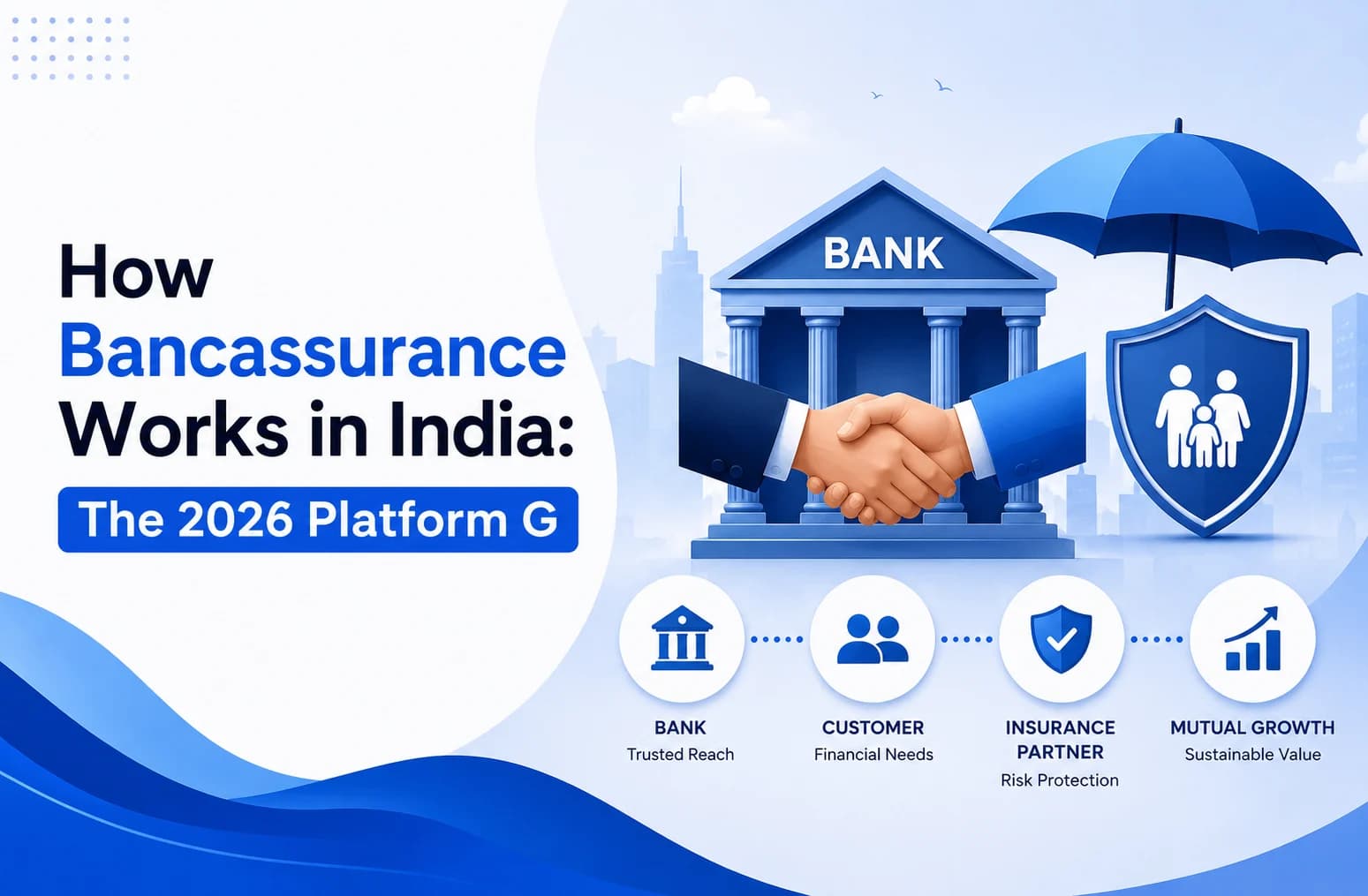
Bancassurance is the model through which banks and NBFCs distribute insurance products to their existing customers using their branch network, mobile apps, and relationship managers. A bank partners with one or more IRDAI-registered insurers under a Corporate Agent licence, embeds insurance offers into its existing customer journeys, and earns fee income on every policy sold without taking on any underwriting risk. In 2026, the channel accounts for 25 to 30% of total insurance premium collection in India, making it the second-largest insurance distribution channel in the country.
What Is the Legal Framework for Bancassurance in India?
The legal foundation is IRDAI's Corporate Agent (Composite) Regulations. Any bank or NBFC that wants to distribute insurance must obtain a Corporate Agent licence from IRDAI. Under this licence, the institution can partner with:
Up to 3 life insurance companies
Up to 3 general (non-life) insurance companies
Up to 3 standalone health insurance companies
The regulations were revised in 2015 to introduce this multi-insurer open architecture, moving away from the original exclusive tie-up model. This means your institution is not locked into a single insurer and can offer customers genuine choice across product types and price points.
IRDAI's ongoing Bima Trinity initiative (Bima Sugam, Bima Vistar, and Bima Vahak) further encourages banks and NBFCs to deepen insurance distribution as part of India's push toward universal coverage. In 2026, IRDAI is also consulting on a transaction-fee reform that would shift commission payments from insurer-funded to a customer-paid model. However, this has not yet become a binding regulation.
For NBFCs, the path to Corporate Agent status runs through the same IRDAI application process, and Deployit's compliance onboarding module provides documentation templates and workflow support throughout.
What Are the Main Bancassurance Models in India?
In practice, Indian banks and NBFCs operate across three distinct distribution models, often in combination.
The Corporate Agency Model
This is the most widely used structure. The bank holds an IRDAI Corporate Agent licence and sells insurance on behalf of its insurer partners. The bank earns a commission on each policy sold. The insurer underwrites and services the policy. The bank bears no claims risk. As of 2025, the pure distributor variant of this model holds a 39% share of the Indian bancassurance market.
The Joint Venture Model
Here, the bank holds an equity stake in the insurance company itself. SBI Life Insurance (SBI and BNP Paribas Cardif), HDFC Life (HDFC and Standard Life), and ICICI Prudential (ICICI Bank and Prudential) are the most prominent examples. The bank benefits from both distribution income and equity returns. This model requires significantly more capital and regulatory complexity and is generally only viable for large scheduled commercial banks.
The Referral Model
Under this lighter-touch arrangement, bank staff refer customers to an insurer's representative, who then completes the sale. The bank earns a referral fee. This model avoids the need for bank staff to hold insurance qualifications but limits revenue upside. Many cooperative banks and smaller NBFCs start here before upgrading to full corporate agency.
For most banks and NBFCs reading this guide, the Corporate Agency Model is the entry point that delivers the best combination of revenue potential, regulatory simplicity, and time to market.
How Does the Technology Stack Work in 2026?
Modern bancassurance does not run on spreadsheets and manual policy forms. The 2026 technology stack connects three systems in real time: your core banking or loan management system, an insurance distribution platform, and the insurer's policy engine.
Here is what a fully integrated bancassurance flow looks like in practice.
Step 1: Customer Event Detection. A trigger event occurs inside your system. A personal loan is disbursed. A salary account is opened. A home loan is sanctioned. Your platform identifies the event and queries the insurance distribution layer.
Step 2: Product Matching The distribution platform maps the customer's profile, transaction type, and eligibility parameters against the insurer catalogue. It returns one or more relevant product offers in real time.
Step 3: Offer Presentation The offer is displayed inside your existing customer interface, whether that is a mobile app, net banking portal, or relationship manager dashboard. The customer sees coverage details, premium amount, and a single-click accept option.
Step 4: Policy Issuance. On acceptance, the platform calls the insurer's API. KYC data already held by your institution is passed through, eliminating re-entry. The policy is issued within the same session. The customer receives confirmation via SMS or email.
Step 5: Premium Collection and Reconciliation Premium is collected through your existing payment rails. The platform generates insurer-ready settlement reports, commission statements, and GST-compliant invoices on a scheduled cycle. Deployit's bank integration module delivers all five steps through a single REST API connection to your CBS or LMS. Pre-built insurer integrations mean you do not negotiate and build each insurer connection from scratch.
Why Are Banks and NBFCs Doubling Down on Bancassurance in 2026?
The financial case has never been clearer. India's insurance penetration sat at just 4.2% of GDP in 2025, against a population of over 1.4 billion. Less than 10% of Indians hold any insurance policy. The gap between what exists and what the market needs is enormous, and banks sit at the only distribution infrastructure capable of closing it at scale. India has over 1.5 lakh bank branches, and hundreds of millions of customers already trust their banks with their savings, loans, and payments.
Four specific pressures are pushing institutions to act now.
Margin compression on core lending. Rising credit costs and tighter NIM spreads are making fee income diversification a necessity rather than a bonus. Insurance commissions are not provisioned, carry no credit risk, and are governed by clear IRDAI guidelines.
Customer retention economics. A customer who holds a loan and an insurance policy with the same institution has measurably higher retention and lower acquisition cost for the next product. The insurance relationship extends the financial relationship.
Regulatory momentum. IRDAI's Bima Trinity and the government's stated goal of "Insurance for All by 2047" mean that institutions actively distributing insurance are aligned with policy direction. This matters in supervisory conversations.
Technology accessibility. In 2020, building a bancassurance integration meant a 12- to 18-month IT project. In 2026, API-first platforms will have pre-built insurer connections, compliance workflows, and white-label customer interfaces ready to deploy in weeks.
What Products Work Best for Bancassurance Distribution?
The products best suited to bancassurance are those that map naturally to an existing financial event and require minimal customer deliberation at the point of sale.
Credit life insurance is the highest-volume product in bancassurance. Attached to any loan disbursal, it covers the outstanding balance if the borrower dies or is permanently disabled. Uptake is near-automatic because the product directly protects the repayment obligation.
Motor insurance aligns with vehicle loan disbursement. Regulatory requirements for third-party motor insurance create a built-in need at the moment of loan sanction.
Home insurance pairs with mortgage disbursement. The customer has just made the largest financial commitment of their life; a structural and contents cover offer at that moment is highly relevant.
Term life and health covers suit salary account opening and credit card activation events, where the customer is in a positive financial moment and receptive to protection products.
Crop and parametric insurance is the frontier for rural NBFCs and microfinance institutions. Parametric products triggered by satellite or weather data can be issued at scale with minimal claims friction, making them viable at ticket sizes that traditional insurance cannot serve.
A practical starting point for most institutions is credit life plus motor, launched together against loan disbursement triggers. See how Deployit structures this in the embedded insurance suite.
What Does It Cost to Launch Bancassurance and How Long Does It Take?
The answer depends on the deployment approach.
Building direct insurer integrations requires negotiating individual data sharing agreements, building API connections with each insurer's policy engine, and obtaining IRDAI documentation approvals independently. This typically costs between INR 50 lakh and INR 2 crore in technology investment and takes 12 to 18 months.
Using an API-first distribution platform like Deplyit removes the direct integration burden. Pre-built insurer connections are already live on the platform. Your institution connects once to the Deployit API, configures product and trigger rules, and goes live. The typical timeline is 4 to 8 weeks. Costs are structured as a platform fee plus a per-policy transaction charge, keeping upfront capital outlay low.
The economics of the platform approach become clear quickly. If your institution disburses 10,000 loans per month and achieves even a 15% insurance attachment rate at an average premium of INR 3,000, that is INR 45 lakh per month in premium flow. Commission income at a 10% average rate is INR 4.5 lakh per month from a single product category. The platform cost is recovered within weeks.
Launch Bancassurance on deployment in under 8 Weeks
Deplyit is India's API-first bancassurance platform built for banks and NBFCs. Pre-integrated insurer partnerships, white-label customer journeys, real-time policy issuance, and compliance-ready documentation are included out of the box. You do not need a 12-month IT project. You need one API connection and a product configuration session.
Start your free trial on Deployit and take your first insurance policy live within the quarter.
- Bancassurance lets banks and NBFCs sell insurance through their existing customer relationships without an insurance licence of their own.
- Banks can partner with up to 3 life, 3 non-life, and 3 standalone health insurers under a single IRDAI Corporate Agent (Composite) Licence.
- The India bancassurance market is valued at USD 111.4 billion in 2025 and is projected to reach USD 182.08 billion by 2034 at a CAGR of 5.62%.
- HDFC Life distributes 65% of its policies through banking channels; SBI Life distributes 60% through bancassurance.
- API-first platforms like Deployit allow banks and NBFCs to go live with bancassurance in weeks, not months.
Have any questions?
Can a cooperative bank or small finance bank get a bancassurance licence?
Yes. IRDAI's Corporate Agent Licence is available to any scheduled bank, cooperative bank, NBFC, or Regional Rural Bank. The eligibility criteria relate to the institution's regulatory standing, not its size. Smaller institutions often find that an API-first platform removes the technology barrier that previously made bancassurance impractical for them.
How many insurers can a bank partner with under the IRDAI Corporate Agent licence?
Under the Corporate Agent (Composite) Licence, a bank or NBFC can partner with up to 3 life insurers, 3 non-life insurers, and 3 standalone health insurers simultaneously. This open architecture model has been in place since the 2015 regulatory revision.
Does bancassurance require dedicated insurance-trained staff?
IRDAI requires that institutions appoint a Principal Officer with relevant insurance qualifications. Front-line staff who actively sell (rather than refer) must also complete IRDAI-specified training. Most platform providers, including Deplyit, include training workflow support as part of their onboarding programme.
What is the difference between bancassurance and embedded insurance?
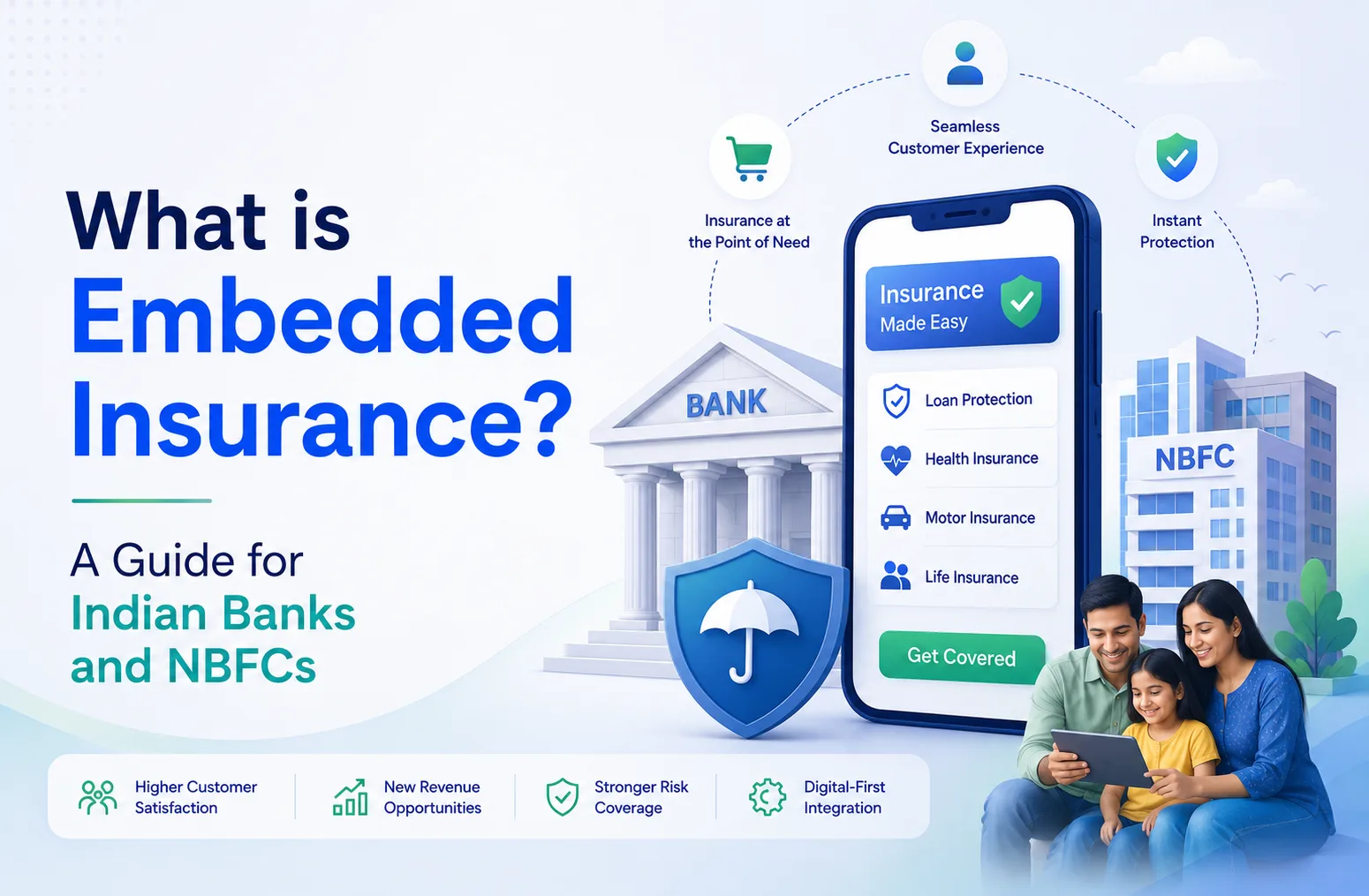
Bancassurance is the broader channel model of banks distributing insurance. Embedded insurance is the specific delivery mechanism: insurance presented and accepted within the flow of a non-insurance transaction, without the customer initiating a separate purchase process. All well-executed bancassurance in 2026 is effectively embedded insurance. The two terms describe the same outcome from different angles
What commissions can banks earn on bancassurance products?
Commission structures are set by IRDAI product regulations and vary by product type. Life insurance commissions range from 2% to 35% of first-year premium depending on the product category. Non-life products typically carry 5% to 15% commissions. Your platform provider should give you a clear commission matrix before you go live.

Ready to distribute health insurance at scale?
Talk to the Deployit team for a 30-minute walkthrough.