
Sachet & Micro Health Insurance in India: A Distribution Playbook
Written by
Shalini
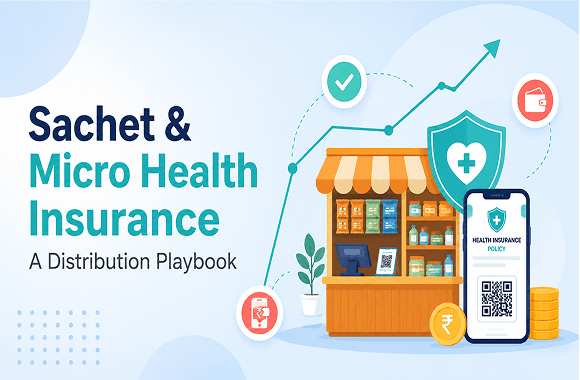
Roughly 450 million informal workers in India have no health cover at all, and standard insurance products are priced well beyond what most of them can pay. Sachet and micro health insurance solves this by breaking protection into small, affordable units, often under Rs. 1,500 a year, sold through banks and NBFCs that already reach these customers. This playbook explains how the pricing and claims model actually works, using IRDAI's Bima Vistaar initiative as a real-world benchmark. It covers how lenders can embed these products into existing loan and account relationships instead of running separate sales campaigns. The focus throughout is on practical distribution mechanics, not just the size of the opportunity.
Sachet & Micro Health Insurance is small-ticket, simplified health cover sold in low-premium units, often bundled with life, accident, or property protection, designed for customers who can't afford or don't need a full-sized comprehensive policy. Banks and NBFCs are uniquely positioned to distribute it because they already reach the exact customer segments (informal workers, small loan borrowers, first-time savers) this product is built for.
Most of the insurance industry's attention goes to comprehensive health plans sold to salaried, urban customers. That leaves a genuinely massive gap: India's informal workforce runs to roughly 450 million people, most of whom have never held any health cover at all. Sachet & Micro Health Insurance in India exists specifically to close that gap, priced in hundreds of rupees rather than thousands, and increasingly distributed through the very institutions, banks, NBFCs, and microfinance lenders, that already touch these customers through savings accounts and small loans. I've spent time helping lenders think through how to distribute this category properly, and the honest answer is that it needs a fundamentally different distribution approach than a standard health policy. This playbook breaks down what sachet and micro health insurance actually is, how it's priced and sold, and how banks and NBFCs can build a program that actually reaches this underserved segment.
What Is Sachet & Micro Health Insurance and How Is It Different From a Regular Policy?
Sachet & Micro Health Insurance is health cover designed around small, affordable premium units, often under Rs. 1,500 annually, with simplified underwriting, minimal documentation, and frequently bundled with other protection like life or personal accident cover. Regular health insurance, by contrast, typically requires medical underwriting, carries higher premiums, and covers a broader range of conditions in more detail.
The term borrows directly from FMCG and telecom, where "sachet" products broke down expensive items into small, affordable units that first-time buyers could try without a big upfront commitment. Insurers have applied the same logic to health cover: instead of asking a daily-wage worker to commit to a Rs. 15,000 annual premium, sachet products offer meaningful protection at a fraction of that cost, even if the coverage itself is narrower or event-based rather than comprehensive.
Micro Insurance vs. Sachet Insurance
Micro insurance is a formally regulated category, defined under the IRDA (Micro-insurance) Regulations, 2005, which allow insurers to design low-premium composite covers specifically for lower-income populations. Sachet insurance is more of an industry and product-design term describing the same broad idea, small, simple, affordable cover, but it isn't always tied to the formal micro-insurance regulatory category. In practice, most sachet products distributed by banks and NBFCs in India today are built under either the micro-insurance framework or IRDAI's regulatory sandbox, which allows insurers to pilot non-standard product designs for 12 to 24 months before seeking full licensing.
Why Are Banks and NBFCs Well Positioned to Distribute Micro Health Insurance in India?
Banks and NBFCs already hold savings accounts, small-ticket loans, and Jan Dhan relationships with exactly the customer segments sachet health insurance targets, giving them a distribution reach that standalone insurers and agents struggle to match. That existing trust and transaction relationship removes much of the customer acquisition cost that typically makes low-premium products commercially unattractive.
India's overall insurance penetration stood at around 4% of GDP in FY23, down from 4.2% the year before, according to a Swiss Re Sigma report, well below the global average of roughly 6.8%. That gap is even wider once you isolate rural and informal-sector populations, which is exactly where most banks and NBFCs already have physical or digital reach through microfinance, small business lending, and basic savings products.
For NBFCs specifically, this connects directly to an existing distribution motion. A lender already collecting small loan repayments or savings deposits from a customer has a natural, low-friction moment to introduce a Rs. 500 or Rs. 1,000 micro health add-on, especially when it's positioned as protecting the same household income the loan itself depends on. This is exactly the kind of cross-sell opportunity that traditional insurance distribution, built around higher-ticket urban products, has historically ignored.
How Does Sachet & Micro Health Insurance in India Actually Get Sold and Priced?
Sachet & Micro Health Insurance in India is typically sold as a simplified, often benefit-based product (a fixed payout on a defined event, like hospitalization, rather than reimbursement of actual medical bills), priced in flat annual premiums and distributed through digital channels, microfinance networks, or embedded into an existing loan or account relationship. Simplified pricing and claims are what make the low premium commercially viable at all.
The mechanics differ meaningfully from a standard indemnity health policy:
Benefit-based structure. Instead of reimbursing actual hospital bills, many sachet products pay a fixed daily cash benefit (commonly Rs. 500 per day, up to a defined cap) for hospitalization, which requires far less documentation to settle a claim.
Flat, simplified premium. Pricing typically isn't individually underwritten based on medical history; it's a flat rate for a defined age band and cover amount, which keeps both the sales process and the pricing model simple enough to distribute at scale.
Bundled protection. Many sachet products combine health cover with life and personal accident protection in a single package, spreading the underwriting and distribution cost across a broader risk pool.
Minimal documentation at purchase. KYC already completed through an existing bank account or loan relationship often suffices, removing the biggest friction point in reaching first-time insurance buyers.
Digital-first or agent-assisted distribution. Products are sold through mobile apps, SMS-based flows, or trained village-level agents, depending on the target customer's digital access and comfort.
A meaningful recent shift for the individual health insurance market: retail and individual health insurance premiums became GST-exempt from September 22, 2025, following a decision from the 56th GST Council, effectively removing an 18% cost layer that previously sat on top of every premium. That change makes small-ticket individual health products, sachet or otherwise, noticeably cheaper for the exact price-sensitive customers they're designed for.
What Is Bima Vistaar and How Does It Change Micro Health Distribution?
Bima Vistaar is IRDAI's flagship bundled insurance product for rural and underserved India, combining life, health, personal accident, and property cover in a single policy priced at roughly Rs. 1,500 per individual, with all 26 life insurers in the country offering it at a uniform price. It represents the most significant standardized push yet to bring sachet-style protection to scale.
The product structure gives a concrete picture of what sachet-style bundling looks like in practice: life cover priced at Rs. 820, health cover (structured as hospital cash) at Rs. 500, personal accident cover at Rs. 100, and property cover at Rs. 80, each carrying a Rs. 2 lakh sum assured for life, personal accident, and property, plus a hospital cash benefit of Rs. 500 per day for up to 10 days, capped at Rs. 5,000. A family floater version costs Rs. 2,420, with an additional Rs. 900 for extended family members.
Distribution for Bima Vistaar is being built around a village-level agent model called Bima Vahak, with IRDAI's stated goal of having at least one Bima Vahak per village going door to door, alongside availability through the Bima Sugam digital marketplace. The insurance industry has also committed roughly Rs. 150 crore over three years specifically for consumer awareness, recognizing that distribution alone doesn't solve the problem if customers don't understand what they're buying.
For banks and NBFCs, Bima Vistaar is worth watching closely, not necessarily as a product to compete with, but as a benchmark for pricing, bundling, and claims simplicity that any bank-led micro health program should be measured against.
Sachet Health Insurance vs. Traditional Health Insurance vs. Group Health: How Do They Compare?
Factor | Sachet & Micro Health Insurance | Traditional Individual Health Insurance | Group Health Insurance |
Typical annual premium | Rs. 300 to Rs. 1,500 | Rs. 5,000 to Rs. 25,000+ | Varies by group size and risk profile |
Underwriting | Simplified or benefit-based, minimal documentation | Full medical underwriting | Collective group risk assessment |
Claim structure | Often fixed-benefit payout | Indemnity-based reimbursement | Indemnity-based reimbursement |
Target customer | Informal workers, low-income households, first-time buyers | Salaried individuals, urban households | Employees of a company or association |
Typical distributor | Banks, NBFCs, microfinance institutions, digital platforms | Agents, brokers, direct online sales | Corporate agents, brokers |
Documentation burden | Minimal, often relies on existing KYC | Moderate to significant | Moderate, managed through employer HR |
Each category serves a genuinely different customer need, and a well-rounded bancassurance strategy for a bank with a broad customer base usually needs all three working alongside each other rather than treating one as a replacement for the others.
How Should Banks and NBFCs Build a Micro Health Insurance Distribution Playbook?
A working playbook needs the product embedded into an existing transaction moment (loan disbursal, account opening, repayment collection), a benefit-based claims structure simple enough to settle quickly, and a distribution channel matched to the customer's actual digital access, whether that's app-based or agent-assisted. Treating sachet insurance as a standalone sales product, disconnected from an existing customer touchpoint, consistently underperforms.
From reviewing how a few lenders have approached this, the programs that actually scale share a specific structure:
Embed the offer into an existing moment, like loan disbursal or a recurring deposit collection, rather than running a separate outbound sales campaign.
Keep the claims process genuinely simple, since a complicated claims experience destroys trust with first-time insurance buyers faster than almost anything else.
Match distribution channel to customer segment, using digital, app-based flows for smartphone-literate customers and agent-assisted models for customers who need in-person guidance.
Price transparently in absolute rupee terms, not percentages or jargon, since customers new to insurance respond far better to "Rs. 500 a year covers this" than to technical premium structures.
This kind of embedded, transaction-linked distribution is exactly what Deployit's platform supports for banks and NBFCs building out embedded insurance journeys, with simplified policy issuance and streamlined claims processes designed for exactly this kind of low-ticket, high-volume product.
What Challenges Do Distributors Face With Sachet & Micro Health Insurance in India?
Even well-intentioned micro health programs run into predictable friction points. The recurring challenges worth planning for:
Thin margins at scale. Low premiums mean commission per policy is small, so profitability depends entirely on volume and low-cost distribution, not high-touch sales.
Customer education gaps. First-time buyers often don't understand what a benefit-based payout actually covers versus a full indemnity policy, which can create dissatisfaction at claim time if expectations weren't set clearly upfront.
Persistency and renewal challenges. Low-income customers with irregular cash flow sometimes lapse on renewal even when they value the cover, making flexible payment timing (linked to a loan repayment cycle, for instance) genuinely important.
Digital access gaps. A purely app-based distribution model excludes customers without reliable smartphone access, which is why agent-assisted channels still matter for large parts of rural and semi-urban India.
Claims trust deficit. First-time buyers are often skeptical that a policy will actually pay out, making fast, simple, well-communicated claims settlement the single most important trust-building factor for renewal and word-of-mouth referral.
Conclusion
The core takeaway: Sachet & Micro Health Insurance in India is a genuine growth opportunity precisely because it targets the roughly 450 million informal workers who've been left out of India's insurance story so far, and banks and NBFCs already sitting inside their financial lives are better positioned to reach them than any standalone insurer or agent network. What makes a program actually work isn't the premium price point, it's embedding the offer into a transaction moment the customer already trusts and keeping claims genuinely simple.
If your institution is exploring this segment, start by mapping which existing customer touchpoint (loan disbursal, savings deposit, repayment collection) offers the most natural moment to introduce a sachet health product, and benchmark your proposed pricing and claims structure against something like Bima Vistaar's simplicity. Deployit's insurance distribution platform is built to handle exactly this kind of low-ticket, high-volume, embedded distribution model, and pairs well with the broader bancassurance guide if you're building this as part of a wider strategy. You can review real deployment scenarios in the case studies section, or talk to the Deployit team about building a sachet or micro health program for your specific customer base.
- Sachet & Micro Health Insurance targets India's roughly 450 million informal workers.
- Products are typically priced under Rs. 1,500 annually, often with benefit-based payouts.
- Banks and NBFCs already reach the exact customer segments this product needs.
- Bima Vistaar bundles life, health, accident, and property cover for about Rs. 1,500 per person.
- GST exemption since September 2025 has made individual health premiums meaningfully cheaper.
- Simplified, fast claims settlement is the biggest trust-building factor for first-time buyers.
- Embedding the offer into an existing loan or account moment drives real distribution scale.
- Micro insurance is a regulated category under the IRDA Micro-insurance Regulations, 2005.
- Thin per-policy margins mean profitability depends on volume, not high commission per sale.
- Distribution channel should match customer digital access, app-based or agent-assisted.
Have any questions?
What is sachet and micro health insurance in India?
Sachet and micro health insurance is small-ticket, simplified health cover priced in low, affordable premiums, often under Rs. 1,500 annually, designed for low-income and first-time insurance buyers who can't commit to a full comprehensive policy. It often uses benefit-based payouts and minimal documentation to keep both pricing and claims simple.
How is sachet health insurance different from a regular health insurance policy?
Regular health insurance typically requires medical underwriting, covers a broad range of conditions through indemnity-based reimbursement, and carries a higher premium. Sachet health insurance uses simplified or benefit-based claim structures, minimal documentation, and much lower premiums, trading some coverage breadth for accessibility and affordability.
Can banks and NBFCs legally distribute micro health insurance in India?
Yes, banks and NBFCs registered as corporate agents can distribute micro health insurance products, and many already do so as an extension of their bancassurance programs. Products are typically offered under the IRDA (Micro-insurance) Regulations, 2005, or through IRDAI's regulatory sandbox for newer, non-standard product designs.
What is Bima Vistaar and how does it relate to sachet insurance?
Bima Vistaar is IRDAI's flagship bundled insurance product combining life, health, personal accident, and property cover for roughly Rs. 1,500 per individual, aimed at rural and underserved populations. It represents a large-scale, standardized version of the same sachet insurance principle: affordable, bundled, simplified protection for customers new to insurance.
Why do sachet health insurance products often pay a fixed benefit instead of reimbursing hospital bills?
Fixed-benefit payouts require far less documentation and verification than indemnity-based reimbursement, which keeps claims processing fast and administrative costs low. That efficiency is essential for a product priced at a few hundred rupees, since a complex claims process would make the product commercially unviable at that price point.
Is micro health insurance profitable for banks and NBFCs to distribute?
Individual policy commissions are small given the low premium, so profitability depends on distribution volume and low customer acquisition cost, which is exactly why embedding the product into an existing loan or account relationship matters. Institutions that treat it as a standalone sales effort, rather than an embedded add-on, typically struggle to make the economics work.
How does GST exemption affect sachet and micro health insurance pricing?
Since September 22, 2025, individual and retail health insurance premiums became GST-exempt following a decision from the 56th GST Council, removing what was previously an 18% cost layer on premiums. This makes small-ticket individual health products meaningfully cheaper for exactly the price-sensitive customers sachet insurance is designed to reach.
What is the biggest challenge in distributing sachet insurance to rural or informal-sector customers?
Customer education and trust are usually the biggest hurdles, since many first-time buyers don't fully understand benefit-based payouts and are often skeptical that a low-premium policy will actually pay a claim. Fast, transparent, well-communicated claims settlement is the single most important factor in building the trust needed for renewal and referral.
Should a bank build its own sachet insurance product or distribute an existing one like Bima Vistaar?
Most banks and NBFCs are better served distributing an existing, insurer-underwritten sachet or micro-insurance product rather than building one from scratch, since designing and pricing a compliant micro-insurance product requires actuarial and regulatory expertise most lenders don't have in-house. The bank's real value-add is distribution reach and embedding the offer into an existing customer relationship, not product design.
Where can sachet and micro health insurance products be purchased in India?
They're typically sold through bank branches, NBFC loan officers, microfinance agents, and increasingly through digital channels linked to an existing bank account or loan relationship. IRDAI's Bima Sugam marketplace is also expected to become a growing digital distribution channel for these products as its rollout continues.
Related insights
 Insurance & Banking
Group Health Insurance Distribution: A Corporate Agent's Playbook
15 July 2026
 Insurance & Banking
How AI Is Transforming Health Insurance Underwriting and Claims in India (for Banks & NBFCs)
15 July 2026
 Insurance & Banking
Credit Life Insurance for Banks & NBFCs: Unlock Fee Income
11 July 2026

Ready to distribute health insurance at scale?
Talk to the Deployit team for a 30-minute walkthrough.