
Group Health Insurance Distribution: A Corporate Agent's Playbook
Written by
Shalini
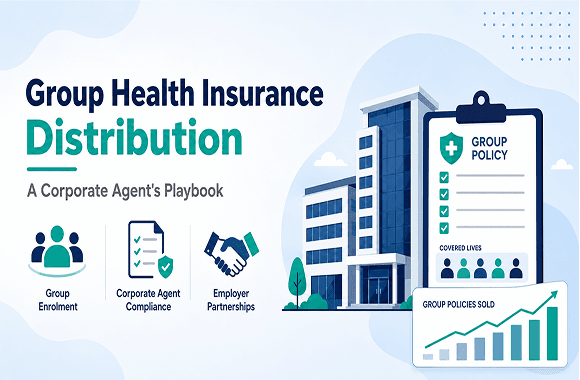
Banks and NBFCs already sit inside thousands of corporate banking relationships, but most treat group health insurance as an afterthought bolted onto retail bancassurance. This playbook explains why that's a mistake, since group and family floater policies now make up the largest single share of India's health insurance market. It breaks down how the corporate agent model actually works, including the wider nine-insurer panel available for health distribution. Readers get a practical structure for segmentation, multi-insurer quoting, and renewal management, not just a market overview. The goal is a genuinely usable playbook, not another generic explainer on what group health insurance is.
Group Health Insurance Distribution is how banks and NBFCs, acting as licensed corporate agents, sell employer-sponsored or association-based health cover to businesses and their employees rather than to individual retail customers. It's the fastest-growing segment of India's health insurance market, and banks sitting on existing corporate banking relationships are unusually well positioned to capture it.
If your bank already has current accounts, working capital loans, or payroll relationships with hundreds of businesses, you're sitting on a distribution advantage most standalone brokers would kill for. The problem is that most banks still treat group health as an afterthought bolted onto their bancassurance program, run through the same generic sales motion built for retail term insurance. That doesn't work. Group health has its own underwriting logic, its own renewal cycle, and its own compliance requirements. In my years working with banks and NBFCs building out corporate agency distribution, group health is consistently the line where a scattered distribution platform shows its cracks fastest, because the product is genuinely more complex than a term policy or a motor add-on. This playbook walks through what group health insurance distribution actually requires, how the corporate agent mechanics work, and where most bank-led programs go wrong.
What Is Group Health Insurance Distribution and Why Are Banks Entering This Market?
Group Health Insurance Distribution means selling a single health policy that covers a defined group, typically a company's employees, rather than individual policies sold one customer at a time. Banks and NBFCs are entering this market because they already hold the corporate banking, current account, and payroll relationships that make them a natural point of contact for an employer shopping for group cover.
Family floater and group health policies together made up the largest single portfolio segment of India's health insurance market in 2025, holding a 43.63% share, according to Mordor Intelligence's analysis of the sector. That's a meaningful signal: group cover isn't a niche add-on to India's health insurance story, it's the largest single piece of it.
For a bank, the appeal is straightforward. A relationship manager who already handles a company's working capital facility or current account has a natural, credible reason to bring up group health cover during a routine business conversation. That's a fundamentally easier sale than cold outreach, and it's exactly why bancassurance programs built for banks increasingly treat group health as a core product line rather than an occasional cross-sell.
Group Health Insurance vs. Retail Health Insurance
Retail health insurance is underwritten against one individual's health profile and sold directly to that person. Group health insurance is underwritten against the risk profile of an entire employee base, priced collectively, and sold through the employer rather than to each employee separately. That single difference changes almost everything downstream, from how underwriting works to who actually signs the policy and who pays the renewal premium.
Why Is Group Health Insurance Growing Faster Than Any Other Insurance Line in India?
Group health insurance is growing quickly because India's formal workforce is expanding, medical inflation keeps pushing employers to offer health benefits as a retention tool, and government schemes are normalizing health coverage as a baseline expectation. Roughly 1.54 million new employees were enrolled under the Employees' State Insurance Scheme in a single month in early 2025, according to India's Ministry of Labour and Employment data cited in recent Asia Pacific market research, a clear signal of formal employment growth feeding directly into group cover demand.
Health insurance overtook motor insurance as the largest segment of India's non-life market, and that shift isn't slowing down. India's overall health insurance market was valued at roughly USD 157.6 billion in 2025 and is projected to keep growing at a strong clip through the next decade, based on IMARC Group's sector analysis. A big part of that growth is employer-driven, not individual-driven, because rising healthcare costs are pushing companies to offer group cover as a genuine hiring and retention lever, not just a compliance checkbox.
There's also a technology tailwind worth knowing about. IRDAI launched the Bima Sugam digital insurance marketplace on September 17, 2025, giving policyholders, insurers, and intermediaries a single platform to compare and manage policies, which is gradually lowering the friction of comparing and switching group health providers. Banks that can move fast on quoting and onboarding through their own integrations layer are better positioned to win business as that comparison friction keeps dropping.
How Does Group Health Insurance Distribution Work Through a Corporate Agent License?
A bank distributes group health insurance under its corporate agent license by tying up with insurers (up to nine for health-focused corporate agents), then selling policies to corporate clients through relationship managers, branch staff, or a digital portal built for employer onboarding. The bank earns commission on the premium without underwriting the health risk itself.
Health-focused corporate agents get more flexibility than a standard corporate agent tied to just three insurers per category; they can work with up to nine insurers for health products specifically. That matters a lot for group health, since different insurers have different appetites for different industries, group sizes, and claims histories. A bank locked into a single insurer relationship will inevitably lose deals where that one insurer simply doesn't want the risk.
Here's how the distribution flow typically runs:
Corporate client identification. The bank's relationship managers flag existing business banking clients who don't yet have group health cover, or whose current cover is up for renewal.
Needs assessment and quoting. Employee headcount, industry risk profile, and desired coverage tiers get fed into the underwriting logic to generate comparative quotes across the insurer panel.
Policy issuance. Once the employer selects a plan, the policy gets issued to cover the defined employee group, typically with provisions for adding new hires and removing departures during the policy year.
Ongoing servicing and renewals. Group health policies renew annually, and pricing shifts based on the group's claims experience, so proactive renewal management matters more here than in most retail insurance lines.
Claims support. Employees within the group file claims individually, but the bank as distributor often still fields escalations, making a responsive claims process part of the bank's own service reputation, not just the insurer's.
What Should a Bank's Group Health Insurance Distribution Playbook Actually Include?
A working group health distribution playbook needs a defined target segment (industry, company size, existing banking relationship), a multi-insurer quoting process, a renewal tracking system tied to claims experience, and a clear escalation path for employee-level claims issues. Without all four pieces, banks typically win the first sale and then lose the renewal.
From reviewing several bank-led group health programs over the past few years, the ones that actually scale share a specific structure:
Segment first, sell second. Banks that target specific industries (IT services, manufacturing SMEs, healthcare staffing) with tailored group health packaging consistently outperform banks running a generic, one-size-fits-all pitch across their entire business banking book.
Bundle group health into existing relationship touchpoints, like working capital renewal conversations or payroll account reviews, rather than treating it as a separate outbound sales motion.
Track claims experience by client, since a group's claims ratio directly affects renewal pricing, and proactive communication about that shift avoids surprising the employer at renewal time.
Give employers a self-service portal for adding and removing employees mid-year, since manual endorsement requests are one of the biggest sources of service friction in group health.
This is exactly the operational structure Deployit builds for NBFCs and banks running group health as a genuine cross-sell motion rather than a side hustle, with renewal tracking and claims visibility built into the same system relationship managers already use for other products.
Group Health vs. Individual Health Insurance Distribution: What Changes for Banks and NBFCs?
Factor | Group Health Distribution | Individual Health Distribution |
Buyer | Employer or association, on behalf of members | The individual policyholder directly |
Underwriting basis | Collective group risk profile | Individual health history and age |
Sales motion | Relationship-led, tied to existing corporate banking | Transactional, often single-touch |
Renewal dynamics | Annual, pricing shifts with group claims experience | Individual renewal, less volatile pricing swings |
Commission structure | Often higher per-policy value due to larger premium pools | Lower per-policy value, higher volume needed |
Service touchpoints | Employer HR team plus individual employee claims | Direct with the policyholder only |
Both channels matter for a well-rounded bancassurance strategy, but group health specifically rewards banks with strong existing business banking relationships, which is exactly where most Indian banks already have an underused advantage.
How Should Banks and NBFCs Choose Insurer Partners for Group Health Distribution?
Banks should choose insurer partners based on industry-specific underwriting appetite, claims settlement speed, and willingness to support digital onboarding for employer HR teams, not just headline commission rates. A single insurer rarely covers every industry and group size a bank's corporate client base actually needs.
Since health-focused corporate agents can tie up with as many as nine insurers, the smarter approach is building a panel with complementary strengths rather than one dominant relationship. One insurer might have stronger appetite for manufacturing and industrial groups, another might specialize in IT and services companies with younger, lower-risk employee bases. Matching the right insurer to the right client segment, rather than pushing every deal through the same carrier, measurably improves both approval rates and long-term claims experience.
A few practical criteria worth prioritizing:
Turnaround time on group quotes, since corporate clients comparing options don't wait around for a slow response.
Claims settlement track record for group policies specifically, not just the insurer's overall retail claims ratio.
API-based integration readiness, since manual, paperwork-heavy onboarding kills the speed advantage a bank's existing relationship is supposed to provide.
Flexibility on mid-year endorsements, since employee headcount changes constantly and a rigid insurer creates ongoing service friction.
What Common Mistakes Undermine Group Health Insurance Distribution Programs?
Even banks with strong corporate relationships stumble on execution. The recurring issues worth watching for:
Treating group health like a retail add-on. The sales conversation, underwriting inputs, and service expectations are genuinely different, and using a retail-insurance playbook for group health consistently underperforms.
Single-insurer dependency. Relying on one carrier limits which industries and group sizes a bank can actually serve well, and it removes negotiating leverage on pricing and terms.
Weak renewal tracking. Group health renewals hinge on claims experience, and banks that don't track this proactively get blindsided by premium increases that upset corporate clients right before renewal.
Manual endorsement processing. Employers adding or removing employees mid-year expect quick turnaround; slow, paper-based endorsement requests are a leading cause of client attrition at renewal.
No clear claims escalation path. When an employee's claim gets stuck, the bank's name is attached to that frustration even though the insurer processes the claim, making a responsive escalation process part of the bank's own reputation management.
Conclusion
The core takeaway: Group Health Insurance Distribution is one of the strongest growth opportunities available to banks and NBFCs with existing corporate banking relationships, but it demands a genuinely different playbook than retail insurance cross-sell, built around segmentation, multi-insurer quoting, and disciplined renewal management. Banks that keep running group health through a generic retail sales motion will keep losing renewals to brokers who specialize in exactly this kind of client servicing.
If your bank is building or scaling a group health program, start by auditing your existing corporate banking book for companies without current group cover, and map which insurer on your panel actually fits each client segment best. That single exercise usually surfaces more near-term opportunity than any new outbound campaign would. Deployit's platform supports this entire distribution lifecycle for banks and NBFCs, from multi-insurer quoting through renewal tracking, and pairs naturally with the broader bancassurance guide if you're building this out as part of a larger distribution strategy. You can see how the underlying system handles real client scenarios in the case studies section, or talk to the Deployit team about building a group health program suited to your existing corporate banking relationships.
- Group Health Insurance Distribution lets banks sell employer-sponsored cover through corporate banking relationships.
- Group and family floater policies made up 43.63% of India's health insurance portfolio in 2025.
- Health-focused corporate agents can tie up with up to 9 insurers, not the usual 3-per-category cap.
- Group health premiums reprice annually based on the group's own claims experience.
- Segmenting the existing corporate banking book is the fastest way to find near-term opportunity.
- A multi-insurer panel outperforms single-insurer dependency for approval rates and pricing.
- Weak renewal tracking and manual endorsements are the top causes of client attrition.
- Bima Sugam, launched September 2025, is lowering friction for comparing group health providers.
- Claims escalation support matters for the bank's reputation, even though insurers process claims.
- A working playbook needs segmentation, multi-insurer quoting, and disciplined renewal management.
Have any questions?
What is group health insurance distribution and how is it different from selling individual policies?
Group health insurance distribution is selling a single health policy that covers a defined group, usually a company's employees, rather than selling separate policies to individuals. The buyer is the employer, underwriting is based on the group's collective risk profile, and pricing shifts annually based on the group's claims experience.
Can a bank sell group health insurance under its corporate agent license?
Yes, banks with a corporate agent license can distribute group health insurance, and health-focused corporate agents specifically get flexibility to tie up with up to nine insurers rather than the standard three-per-category limit. This wider panel helps banks match different corporate clients to insurers with the right underwriting appetite.
Why is group health insurance growing faster than other insurance lines in India?
Growth is driven by expanding formal employment, rising medical inflation pushing employers to offer health benefits as a retention tool, and government initiatives normalizing health coverage as a baseline expectation. Health insurance has overtaken motor insurance as the largest segment of India's non-life insurance market as a result.
Should a bank use one insurer or multiple insurers for its group health distribution playbook?
Multiple insurers almost always perform better, since no single carrier has strong underwriting appetite across every industry and group size a bank's corporate client base includes. A panel of two to three insurers with complementary strengths typically improves both approval rates and pricing outcomes for clients.
How does group health insurance pricing change at renewal?
Group health premiums are repriced annually based largely on the group's claims experience over the prior policy year; a group with high claims volume typically sees a premium increase, while a low-claims group may retain flat or even reduced pricing. Proactive communication about this shift before renewal helps avoid surprising corporate clients.
What happens if an employee's group health claim gets delayed or rejected?
The insurer processes and decides the claim, but the bank distributing the policy often still fields the employer's or employee's frustration, since the bank's relationship is what brought the client to that insurer in the first place. A clear escalation path between the bank and insurer is essential for protecting the bank's own service reputation.
Is group health insurance distribution profitable enough for banks to prioritize over other insurance lines?
Group health typically carries higher premium volume per client than individual policies, since one corporate account can cover hundreds of employees under a single policy, which usually makes the commission economics more attractive per relationship managed. It also strengthens the bank's existing corporate banking relationship, adding retention value beyond the direct commission.
How do employers add new employees to an existing group health policy mid-year?
Most insurers support mid-year endorsements, where new hires get added to the group policy as they join, typically through an HR portal or a request submitted through the distributing bank or broker. Insurers with slow or manual endorsement processes create ongoing service friction, which is why banks should prioritize insurer partners with digital onboarding support.
What role does IRDAI's Bima Sugam platform play in group health insurance distribution?
Bima Sugam, launched in September 2025, is a government-backed digital marketplace letting policyholders, insurers, and intermediaries compare and manage policies on one platform, gradually reducing the friction of comparing group health providers. This makes speed and service quality more important competitive factors for banks distributing group health, since comparison shopping is becoming easier for corporate buyers too.
What should be the first step in building a group health insurance distribution playbook for a bank?
Start by segmenting your existing corporate banking book to identify companies without current group health cover, since this list represents the most efficient near-term opportunity given the relationship you already have. From there, build a multi-insurer panel matched to your top client segments before investing heavily in outbound sales effort.
Related insights
 Insurance & Banking
How AI Is Transforming Health Insurance Underwriting and Claims in India (for Banks & NBFCs)
15 July 2026
 Insurance & Banking
Credit Life Insurance for Banks & NBFCs: Unlock Fee Income
11 July 2026
 Insurance & Banking
Insurance Mis-Selling in Indian Banks: What RBI and IRDAI Now Require
9 July 2026

Ready to distribute health insurance at scale?
Talk to the Deployit team for a 30-minute walkthrough.