
How AI Is Transforming Health Insurance Underwriting and Claims in India (for Banks & NBFCs)
Written by
Shalini
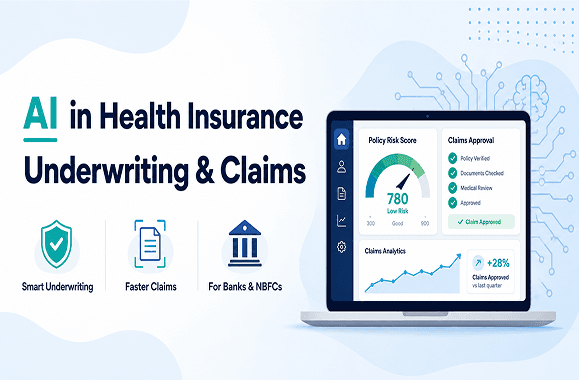
How AI is transforming health insurance in India is a genuine operational shift, not marketing language, with underwriting timelines collapsing and claims resolving dramatically faster, but the regulatory framework governing that shift is still being written, with IRDAI's working group due to report within the current financial year.
How AI is transforming health insurance comes down to speed and accuracy: underwriting decisions that used to take days now happen in minutes, and claims that once took weeks now settle in hours, with straight-through processing rates jumping from 10 to 15% up to 70 to 90% at insurers using mature AI models. For banks and NBFCs distributing health cover, that shift changes what a good distribution partner actually needs to offer.
India's health insurance market was valued at USD 157.62 billion in 2025 and is projected to nearly double to USD 322.10 billion by 2034, according to IMARC Group's market analysis, and a growing share of that growth is being driven by AI-based underwriting, fraud analytics, and digital claims platforms rather than traditional agent-led distribution. I've spent the last year watching banks and NBFCs evaluate AI-enabled insurance partners, and the pattern is clear: the ones asking the right questions about explainability and governance are the ones actually ready for what's coming. IRDAI just formed a dedicated working group on AI governance in June 2026, which tells you this isn't a future consideration anymore, it's an active regulatory priority. This guide walks through exactly how AI is reshaping underwriting and claims, what it means for lenders distributing health cover, and how to build a distribution setup that's ready for where this is heading.
What Is the Role of AI in Health Insurance Underwriting and Claims?
The role of AI in health insurance is to replace slow, manual, rule-based decision-making with automated risk scoring and document processing, using machine learning models trained on medical histories, claims patterns, and behavioral data. This lets insurers assess risk in minutes instead of weeks and flag suspicious claims before payout instead of after.
Underwriting used to run on static questionnaires and human judgment calls that varied depending on which underwriter reviewed the file. AI-powered underwriting is different because it pulls structured and unstructured data (medical records, historical claims, sometimes wearable or lifestyle data) into a single risk model that scores an applicant consistently, every time. On the claims side, natural language processing automates document review, while anomaly detection algorithms flag patterns that look statistically unusual compared to millions of prior claims, catching fraud earlier than a human reviewer working case by case ever could.
AI in Underwriting vs. AI in Claims: Two Different Jobs
It's worth separating these because they solve different problems. AI in underwriting is about pricing risk accurately before a policy is issued, pulling in data sources a human underwriter couldn't manually process at scale. AI in claims is about verifying and settling a claim quickly after it's filed, automating document checks and fraud detection so straightforward claims don't sit in a manual review queue for weeks.
How Is AI Transforming Health Insurance Underwriting in India?
AI is transforming health insurance underwriting in India by cutting decision timelines from weeks to minutes and improving risk assessment accuracy through data enrichment across medical records, claims history, and increasingly wearable device data. Straight-through processing rates, the share of applications approved without any manual intervention, have climbed from roughly 10 to 15% to 70 to 90% at insurers with mature AI deployments, according to recent insurtech industry analysis.
That jump matters more than it sounds like on paper. A traditional health insurance application involving medical underwriting could take anywhere from a few days to a few weeks, depending on how complex the applicant's health history was and how quickly documents moved between departments. AI models trained on large historical datasets can now score that same risk profile in minutes, using data enrichment techniques that pull in far more signal than a single underwriter reviewing a paper file ever could.
India's health insurance market forecasts specifically call out AI-driven personalized underwriting as a defining trend through 2034, with insurers expected to move toward risk-based premium pricing using individual health record and wearable data, rather than broad demographic-based pricing bands. That shift toward individualized, continuously updated risk assessment is a meaningfully different underwriting model than the annual, static approach the industry has run on for decades.
How Is AI Changing Health Insurance Claims Processing for Banks and NBFCs?
AI is changing health insurance claims processing by automating document verification and fraud detection, cutting processing times by up to 70% and improving fraud detection accuracy by 30 to 60% compared to older rule-based systems. For banks and NBFCs distributing health cover to loan customers, faster and more transparent claims directly reduce the complaint and reputational risk tied to a slow, opaque process.
This is where distribution partners feel the impact most directly, even though the actual claims processing happens on the insurer's side. A borrower who bought a health policy through their bank and then experiences a frustrating, multi-week claims process is going to associate that frustration with the bank, not just the insurer. Faster AI-driven claims resolution protects the distribution relationship as much as it protects the insurer's loss ratio.
Here's what's changed concretely on the claims side:
Automated document review using natural language processing pulls the relevant medical and billing details from submitted paperwork instead of requiring manual data entry.
Anomaly detection algorithms flag claims that statistically resemble known fraud patterns, catching issues before payout rather than through post-payment audits.
Faster settlement timelines, with straightforward claims increasingly resolved in under 24 hours at insurers running mature AI claims pipelines, based on recent industry benchmarking.
Reduced manual errors, since automated systems apply the same evaluation logic consistently, rather than varying by which claims handler reviews the file.
AI-Driven vs. Traditional Underwriting and Claims: A Side-by-Side Comparison
Factor | Traditional Process | AI-Driven Process |
Underwriting decision time | Days to a few weeks | Minutes to hours |
Straight-through processing rate | Roughly 10 to 15% | 70 to 90% at mature deployments |
Claims processing time | Days to weeks | Cut by up to 70%, often under 24 hours for simple claims |
Fraud detection method | Manual review, post-payment audits | Anomaly detection, pre-payment flagging, 30 to 60% more accurate |
Risk assessment basis | Static questionnaires, demographic bands | Individual medical history, claims patterns, wearable data |
Consistency across cases | Varies by underwriter or claims handler | Consistent scoring logic applied uniformly |
The gap between these two columns is exactly why AI adoption has moved from an experimental IT project to a genuine competitive differentiator for insurers and their distribution partners alike.
What Is IRDAI's New AI Governance Framework, and What Does It Mean for Distributors?
IRDAI formed a seven-member working group on artificial intelligence on June 19, 2026, tasked with mapping current AI adoption across insurers and proposing a framework for ethical, transparent, and explainable AI use, with specific attention to claims processing and fraud detection. The group has a three-month deadline, meaning India's first formal AI governance framework for insurance is likely to take shape within the current financial year.
This follows IRDAI's revised information and cyber security guidelines, issued in April 2026, which already directed regulated entities to begin compliance work in the current financial year. The AI working group extends that direction into new territory: governance over automated decision-making itself, not just the security infrastructure around it.
For banks, NBFCs, and other distributors, the practical implication is straightforward. As one industry analysis published in Insurance Business magazine noted, regulatory catch-up on AI liability has been slower than adoption itself, since most current use cases remain concentrated in customer service rather than full-scale underwriting and claims automation. That gap is exactly what IRDAI's working group is trying to close, and distributors relying on insurer or platform partners for AI-driven underwriting and claims should expect explainability and audit trail requirements to tighten meaningfully once the framework lands.
Insurers and technology partners that wait for the final rules before assessing their AI governance posture are likely to find themselves compressed for time once the framework is published. Auditing current AI deployments and identifying governance gaps now is considerably less disruptive than doing it under active regulatory pressure later.
What Are the Risks and Limitations of AI in Health Insurance?
The biggest risks are proxy discrimination, where a model uses a data point correlated with a protected characteristic without ever using that characteristic directly, and unclear accountability when an automated decision goes wrong. These aren't hypothetical concerns; they're exactly the issues regulators globally, and now IRDAI specifically, are building governance frameworks to address.
A model that identifies certain postcodes as higher risk, for example, might effectively be pricing based on socioeconomic or demographic patterns correlated with that geography, even though geography alone was the stated input. This is a well-documented failure mode in insurance AI, and it's precisely why explainability, meaning insurers can show regulators and customers how a decision was actually reached, has become a non-negotiable requirement rather than a nice-to-have.
There's also a genuine skills gap issue. GlobalData's job market research recorded roughly 63,293 active insurance AI-related job listings globally in 2025, a jump of about 51% from the year before, reflecting how much organizations are still scrambling to build internal expertise rather than having it already in place. Distributors partnering with insurers or platforms on AI-driven underwriting should ask directly how override authority works when a model's decision looks questionable, since human oversight remains a core expectation from every regulator watching this space, IRDAI included.
How Should Banks and NBFCs Prepare Their Distribution Systems for AI-Driven Health Insurance?
Banks and NBFCs should prioritize insurer and platform partners who can demonstrate explainable, auditable AI models rather than just fast turnaround times, since speed without governance is exactly what regulators are moving to constrain. Distribution infrastructure needs to support that transparency too, not just pass the underwriting decision through as a black box.
A few practical steps worth taking now:
Ask partners for model explainability documentation, not just performance metrics, before integrating any AI-driven underwriting flow into your distribution journey.
Build audit trails into your own systems, so you can show, if asked, exactly what data informed a given underwriting or claims outcome your customers experienced.
Keep a human review path available for edge cases and customer complaints, since regulators consistently expect human oversight to remain part of the process.
Track claims resolution speed as a distribution metric, not just an insurer metric, since your customers will associate a slow claims experience with your brand regardless of which company underwrote the policy.
Deployit's platform is built around this kind of transparent, auditable distribution infrastructure for banks, NBFCs, and insurers, with dedicated underwriting and claims modules designed to keep every decision traceable, which matters a great deal more now that IRDAI's governance framework is actively taking shape.
Conclusion
The single takeaway: how AI is transforming health insurance in India is a genuine operational shift, not marketing language, with underwriting timelines collapsing and claims resolving dramatically faster, but the regulatory framework governing that shift is still being written, with IRDAI's working group due to report within the current financial year. Banks and NBFCs distributing health insurance need to move on two tracks at once: adopting the efficiency gains AI genuinely offers, while building the explainability and audit infrastructure that upcoming regulation is clearly going to require.
The practical next step is to audit your current distribution partners on exactly this basis: can they explain how an underwriting or claims decision was reached, and can you trace that explanation if a regulator or a customer asks? If the answer is unclear, that's the gap worth closing before IRDAI's framework becomes formal policy rather than after. Deployit's insurance distribution platform is built with this kind of traceability as a core feature, and you can see how it holds up in real deployments through the case studies section, or check the ISNP and IRDAI compliance guide for the broader regulatory picture. If you'd like to walk through how it applies to your specific distribution setup, talk to the Deployit team or book a demo.
- AI is cutting health insurance underwriting decisions from weeks to minutes.
- Straight-through processing rates have risen from 10-15% to 70-90% at mature AI deployments.
- AI claims processing cuts settlement time by up to 70% and improves fraud detection by 30-60%.
- India's health insurance market is projected to reach USD 322.10 billion by 2034.
- IRDAI formed a 7-member AI working group in June 2026 with a 3-month deadline.
- IRDAI's April 2026 cyber security guidelines already required current-year compliance.
- Proxy discrimination remains a central bias risk in AI-driven underwriting models.
- Banks and NBFCs should evaluate AI partners on explainability, not just speed.
- Claims experience reflects on the distributor's brand, even though insurers process claims.
- Building audit trails now is easier than retrofitting compliance after rules are finalized.
Have any questions?
How is AI transforming health insurance underwriting and claims in India?
AI is cutting underwriting decision times from days or weeks down to minutes, with straight-through processing rates rising from roughly 10 to 15% to 70 to 90% at mature deployments. On the claims side, AI is reducing processing time by up to 70% and improving fraud detection accuracy by 30 to 60% through automated document review and anomaly detection.
What is the role of AI in health insurance for banks and NBFCs?
For banks and NBFCs, AI's role is mostly indirect but still consequential: faster, more accurate underwriting and claims from insurer or platform partners directly affects the customer experience of the health insurance products they distribute. A slow or opaque claims process reflects on the distributor's brand, not just the underwriting insurer.
Is IRDAI regulating the use of AI in health insurance yet?
IRDAI formed a seven-member AI working group on June 19, 2026, with a three-month deadline to propose a governance framework focused on ethical, transparent, and explainable AI, especially in claims processing and fraud detection. While the recommendations won't automatically carry regulatory force, IRDAI's pattern with recent cyber security guidelines suggests formal rules will follow quickly.
How much faster is AI-driven health insurance underwriting compared to traditional methods?
Traditional health insurance underwriting can take anywhere from a few days to several weeks, particularly for applications requiring detailed medical review. AI-driven underwriting models can score the same risk profile in minutes by pulling in structured and unstructured data far more comprehensively than a manual review process allows.
Can AI models in health insurance be biased or discriminatory?
Yes, this is a well-documented risk called proxy discrimination, where a model uses a data point correlated with a protected characteristic, like certain postcodes correlating with ethnicity, without using that characteristic directly as an input. This is exactly why explainability and bias testing have become central requirements in emerging AI governance frameworks, including IRDAI's.
Should banks choose an insurance distribution partner based on AI capability alone?
No. Speed and automation matter, but banks should prioritize partners who can demonstrate explainable, auditable AI models with genuine human oversight options, since regulators are moving to require exactly that transparency. A fast but opaque AI system creates real regulatory and reputational risk down the line.
Why is claims processing speed important for banks distributing health insurance?
Customers who buy health insurance through a bank associate their claims experience with that bank's brand, even though the insurer underwrites and processes the claim. A slow, frustrating claims process creates reputational damage for the distributor, which is why AI-driven claims automation matters to lenders even though they don't run the claims process themselves.
What data does AI use for health insurance underwriting in India?
AI underwriting models typically draw on medical history, prior claims data, and increasingly wearable device and lifestyle data, enabling more individualized risk assessment than traditional demographic-based pricing bands. Industry forecasts point to this kind of personalized, data-driven underwriting becoming increasingly standard through the next decade.
How big is the AI-driven health insurance opportunity in India right now?
India's health insurance market was valued at USD 157.62 billion in 2025 and is projected to reach USD 322.10 billion by 2034, with AI-based underwriting, fraud analytics, and digital claims platforms specifically called out as major growth drivers alongside traditional distribution channels. Investor interest in this space has grown accordingly, with several major funds participating in recent InsurTech funding rounds.
What should banks and NBFCs do now to prepare for AI-driven health insurance regulation in India?
Start by auditing current distribution and insurer partners for AI explainability, not just speed or claims ratios, and build internal audit trails so decisions affecting your customers can be traced if regulators or customers ask questions. Acting before IRDAI's governance framework becomes formal policy is considerably less disruptive than retrofitting compliance under time pressure afterward.
Related insights


Ready to distribute health insurance at scale?
Talk to the Deployit team for a 30-minute walkthrough.