
Bancassurance vs Corporate Agency Licence: What Should Indian Banks Choose in 2026
Written by
Shalini
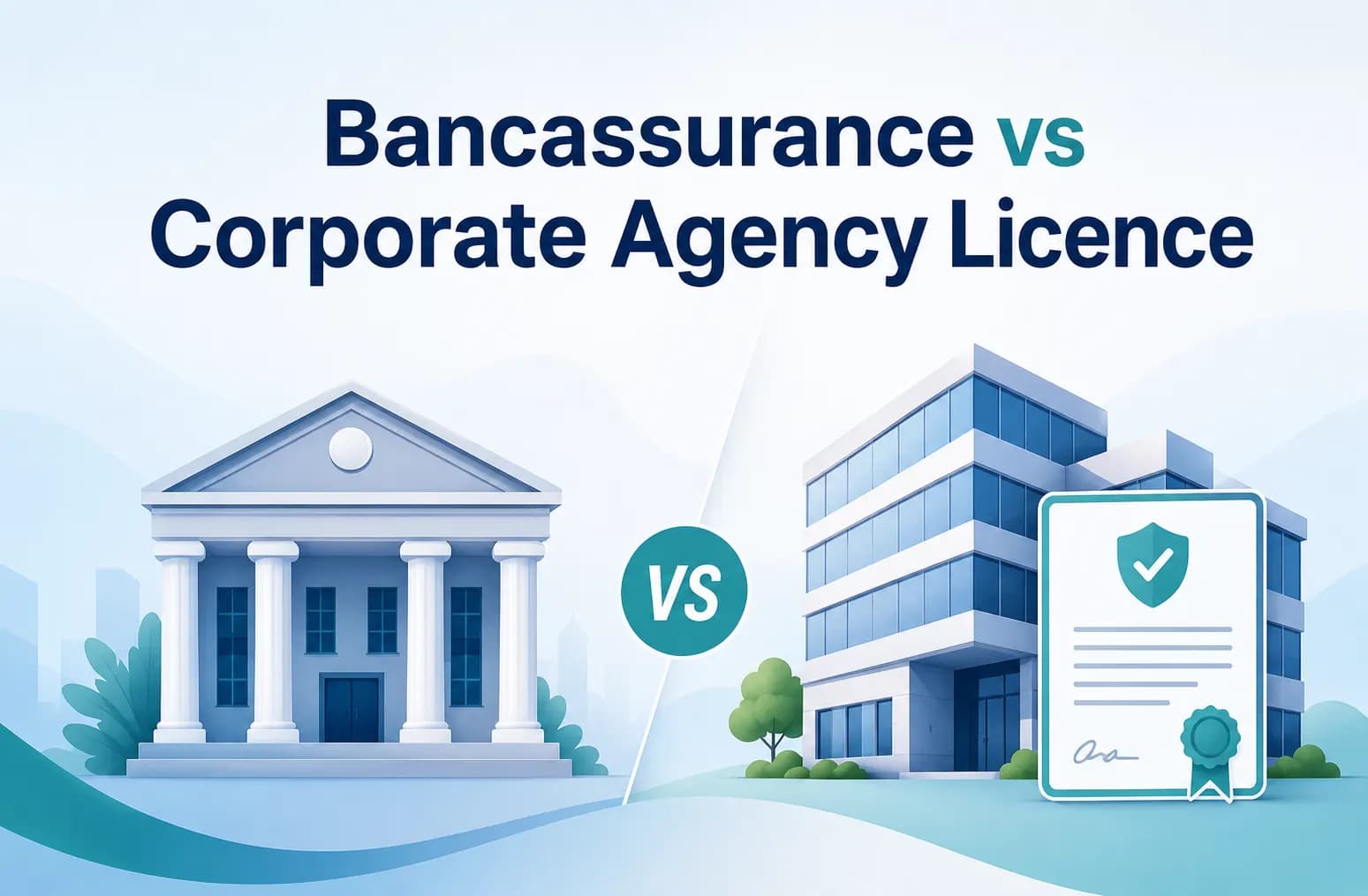
Bancassurance is a distribution channel, not a licence in its own right. Indian banks enable it through one of three underlying registrations: a referral arrangement, a corporate agency licence allowing up to nine insurers per line of business, or a separately capitalized broking subsidiary with whole-market access. Most banks operate as corporate agents, trading broader market access for lower compliance and capital burden.
The confusion this title is trying to clear up
Search for how banks distribute insurance in India and the terms bancassurance and corporate agency get used almost interchangeably, which creates a real misunderstanding for anyone trying to actually build or evaluate a program. The clearest way to state the relationship: bancassurance is not a licence at all, it is a description of what is happening, a bank selling insurance products to its own customers. Corporate agency is one of the actual IRDAI registrations that makes that legal. A bank cannot apply for "a bancassurance licence" because no such thing exists; it applies for a corporate agency registration, or in some cases sets up a broking subsidiary, and the resulting distribution activity is what gets called bancassurance. This distinction is not pedantic. It determines what a bank is actually allowed to do, how many insurers it can work with, how much it can earn, and how much compliance infrastructure it needs to run.
What bancassurance actually is
Bancassurance is the distribution of insurance products through a bank's branches, relationship managers, and digital channels, using the trust, KYC-complete customer data, and existing footfall a bank already has. The channel opened in India in 2002, when banks were first
permitted to act as corporate agents, and expanded materially through liberalizations in 2015 and 2022 that raised the number of insurer partnerships a bank could hold. It works because banks possess something insurers cannot easily replicate on their own: an existing relationship with a customer base that trusts the institution enough to hold deposits and loans with it, plus data and moments, a loan sanction, a salary credit, a fixed deposit maturity, where insurance is genuinely relevant rather than a cold sell. With India's insurance penetration still around 3.7% of GDP as of FY25, per IRDAI and IBEF data, bancassurance remains one of the most efficient channels for reaching an under-insured population that already banks somewhere.
The three licensing structures underneath it
What actually varies between banks is not whether they "do bancassurance," almost all of them do in some form, but which structure they run it under. A referral model is the lightest touch: the bank passes qualified leads to an insurer, who completes the sale independently. The bank earns a referral fee, takes on essentially no operational burden, and correspondingly earns the least. This is common for banks testing whether a customer segment or product actually has demand before committing further. A corporate agency is the structure most Indian banks actually operate under. The bank itself sells through its own certified Specified Persons and channels, earning full commission on business placed with its partner insurers. Under the 2022 Corporate Agency amendment, a bank can hold this kind of relationship with up to nine insurers each in life, general, and health lines, a tie-up limit that applies per line of business rather than in aggregate. This is a meaningful jump from the pre-2015 rule that limited a corporate agent to a single insurer, and it is what allows a bank to offer genuine multi-insurer comparison on a single sale rather than steering every customer to one carrier regardless of fit. A broking subsidiary is the heaviest structure: a separately licensed and capitalized entity that can place business with any insurer in the market, with no nine-insurer cap. This gives the widest possible product shelf and, typically, the best economics per policy, but it comes with its own capital adequacy requirements, its own compliance regime, and meaningfully more operational overhead than either of the other two paths.
Why most banks land on corporate agency
For the large majority of Indian banks, corporate agency is the structure that best balances reach against complexity. Nine insurers per line is enough to offer genuine choice and competitive pricing on most retail products, particularly when a bank chooses an openarchitecture approach with multi-insurer comparison built into every sale, rather than steering customers toward one or two anchor insurers regardless of fit. It also avoids the separate capitalization and licensing burden of a broking subsidiary, which only tends to make sense for banks that view insurance distribution as a strategic, standalone business line rather than a value-added channel on top of lending and deposits. The economics can still be substantial under this model. A worked example: a 500-branch bank activating 70% of its branches, at four policies per branch per month, and an eighteenthousand-rupee average premium, writes roughly thirty crore of annualized premium. At a blended fifteen percent commission, that is approximately four and a half crore of fee income, before digital channels and renewal persistency compound the number further.
What stays the same regardless of which model a bank chooses
Whichever licensing structure a bank operates under, certain compliance obligations do not change. Every sale must be attributable to a certified Specified Person, a role with its own auditable certification record. A documented suitability assessment and benefit illustration acknowledgment are required before a sale completes, and for credit-linked covers specifically, the premium must appear in the loan's Key Facts Statement. Commission payouts must be validated against IRDAI's prescribed caps by product line, with a complete, inspectable register. And conduct expectations prohibit forced bundling entirely, with credit-linked insurance in particular required to carry a genuine, logged opt-out. These requirements exist independent of the underlying licence structure, which is why the technology layer supporting a bancassurance program matters as much as which licence the bank holds. A referral desk, a corporate agency sales floor, and a broking subsidiary's advisors all need the same underlying capabilities: Specified Person management and attribution, in-flow suitability capture, and commission reconciliation against caps, covered in more detail in DeployIT's bancassurance guide and solutions for banks.
Why most banca programs still underperform, regardless of licence
A bank can hold the right licence and still run an underperforming program, and the common failure modes have little to do with which structure was chosen. Tie-ups get signed with several insurers, but branches are never trained or given a daily journey to actually sell through. Relationship managers juggling six different insurer portal logins end up selling close to nothing, because the friction of switching systems outweighs the incentive to sell. Digital channels, a mobile app or netbanking portal, offer nothing contextual and correspondingly convert nothing. And compliance gets handled reactively, with Specified Person attribution and suitability records reconstructed at audit time rather than captured as the sale happens. Digitized bancassurance deployments that fix these specific failure points report meaningfully different outcomes: roughly 70% branch activation within 90 days, three times the digital attach rate compared with untargeted offers, and policy issuance inside a six-minute branch counter interaction. None of this depends on which of the three licence structures the bank holds; it depends on whether the technology underneath the licence actually removes the friction that stops staff and channels from selling.
Choosing a structure: a practical framework
A bank testing whether a customer segment wants insurance at all, without committing significant infrastructure, should start with a referral arrangement or a narrow corporate agency pilot. A bank running an established branch and digital network that wants insurance as a genuine fee-income line, the position most Indian banks are actually in, should operate as a corporate agent with up to nine insurers per line and invest in the technology to activate branches and digital channels properly. A bank that views insurance distribution as a core strategic business, not just a cross-sell channel on top of banking, should evaluate a broking subsidiary, accepting the added capital and compliance burden in exchange for whole-market access and the best per-policy economics.
- Bancassurance describes the act of a bank selling insurance to its customers; it is not itself an IRDAI registration; it is enabled by one of three underlying licence structures.
- The corporate agency model, used by most Indian banks, permits partnerships with up to nine insurers per line of business (life, general, health) under the 2022 IRDAI amendment.
- A referral model earns only referral fees with minimal effort and minimal income, while a broking subsidiary gives whole-market access at the cost of separate capitalization and a heavier compliance load.
- Every model requires certified Specified Persons, documented suitability checks, and commission-cap compliance regardless of which licensing structure sits underneath it.
- The choice between models should follow the bank's ambition and scale: referral for testing the channel, corporate agency for most activated programs, and broking subsidiary for banks wanting full market access as a strategic business line.
Have any questions?
Is bancassurance a separate IRDAI licence?
No. Bancassurance describes a bank distributing insurance to its customers; the underlying legal registration is typically a corporate agency licence, occasionally a referral arrangement or broking subsidiary.
How many insurers can a bank partner with under a corporate agency structure?
Up to nine insurers each in life, general, and health lines, under IRDAI's 2022 Corporate Agency amendment, with the limit applying per line of business rather than in total.
Why would a bank set up a broking subsidiary instead of operating as a corporate agent?
For whole-market insurer access with no nine-insurer cap, typically chosen by banks treating insurance distribution as a core strategic business rather than a value-added channel.
Does the technology a bank uses change depending on which licence structure it holds?
The underlying compliance requirements, Specified Person attribution, suitability capture, and commission reconciliation are consistent across models, so the same platform layer typically supports referral, corporate agency, and broking structures alike.
What is the most common reason a bancassurance program underperforms even with the right licence in place?
Tie-ups without activation: insurers are signed but branches, relationship managers, and digital channels are never given a working daily journey to actually sell through.


Ready to distribute health insurance at scale?
Talk to the Deployit team for a 30-minute walkthrough.